Verse 7
Shlokamanuensis's hand
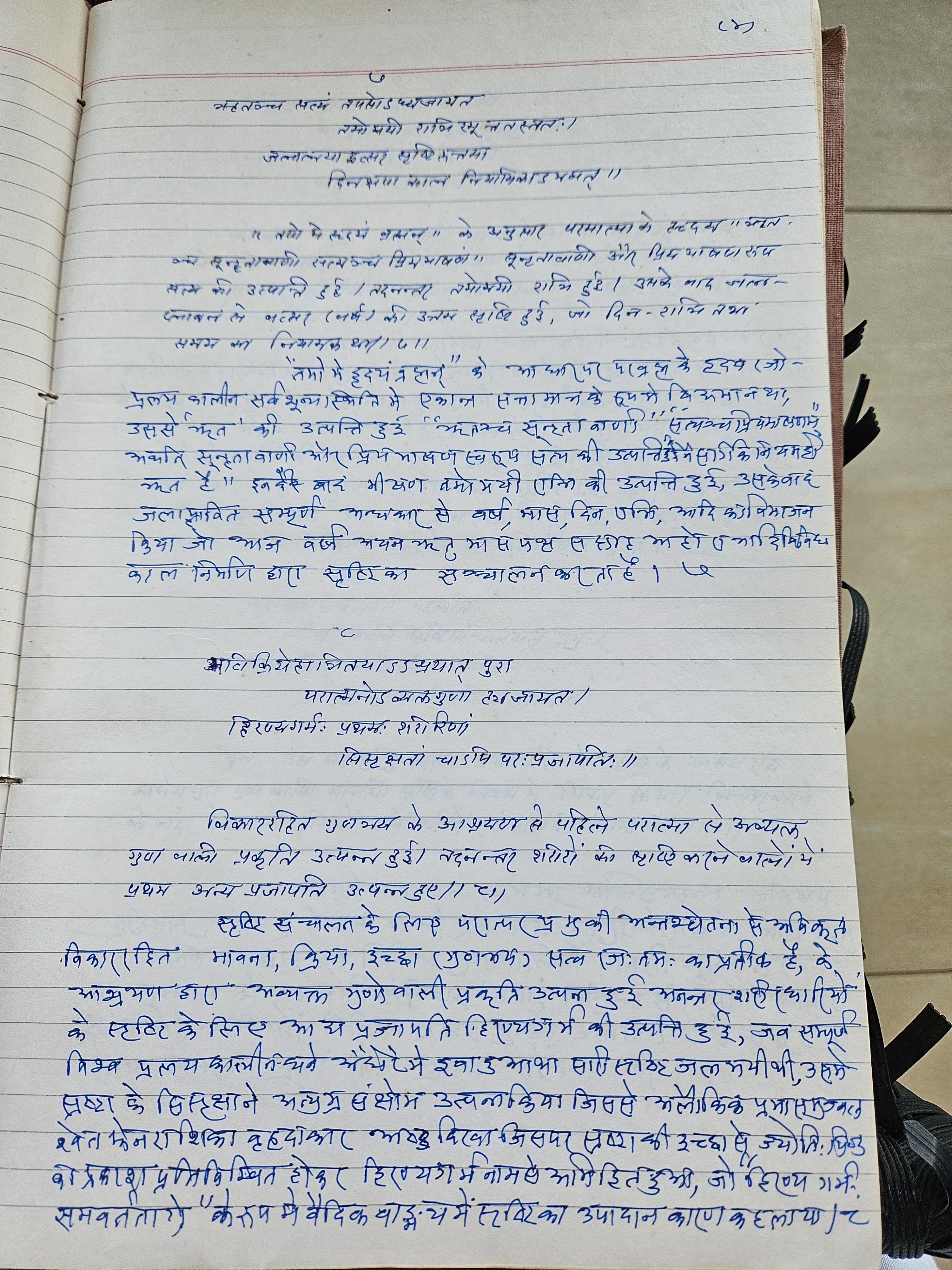
ऋतञ्च सत्यं तपसोऽध्यजायत
तमोमयी रात्रिरभूत्ततस्ततः ।
जलाप्लवाद्वत्सरसृष्टिरुत्तमा
दिनक्षपाकालनियामकोऽभवत् ॥ ७ ॥
Manuscript NoteAI-assisted transcription
वृत्त: वंशस्थ। पूर्व प्रतिलेख में इस श्लोक के स्थान पर ऋग्वेद (१०.१९०.१–२) का अघमर्षण सूक्त रखा गया था, जो हस्तलेख में नहीं है; कवि का अपना श्लोक ऊपर है। पाद ३ "रुत्तमा" अनुवाद "उत्तम सृष्टि" से पुष्ट।
Manuscript Note (EN)AI-assisted transcription
Metre: Vaṃśastha. The earlier transcript put the Ṛgvedic aghamarṣaṇa hymn (RV 10.190.1–2) in place of this verse; that hymn is not in the manuscript. The poet's own verse is given above. Pāda 3 "रुत्तमा" is confirmed by the Hindi "उत्तम सृष्टि".
English Translation (of the Sanskrit)AI-assisted translation
Order (ṛta) and truth were born from austerity; then dark night came into being; then, from the flood of waters, the excellent creation of the year, which became the regulator of day, night and time. (7)
Translationamanuensis's hand
"तपो मे हृदयं ब्रह्मन्" के अनुसार परमात्मा के हृदय से "ऋतञ्च सूनृता वाणी सत्यञ्च प्रियभाषणम्" सूनृता वाणी और प्रियभाषणरूप सत्य की उत्पत्ति हुई। तदनन्तर तमोमयी रात्रि हुई। उसके बाद जल-प्लावन से वत्सर (वर्ष) की उत्तम सृष्टि हुई, जो दिन-रात्रि तथा समय का नियामक था ॥ ७ ॥
English Translation (of the Hindi)AI-assisted translation
According to "austerity is my heart, O Brahman", from the heart of the Supreme Self arose truth, in the form of gracious speech and pleasant words ("ṛta is gracious speech, satya is pleasant speech"). After that came dark night. Then, from the flood of waters, came the excellent creation of the year (vatsara), which was the regulator of day, night and time. (7)
Notesgrandfather's hand
"तपो मे हृदयं ब्रह्मन्" के आधार पर ब्रह्म के हृदय जो प्रलयकालीन सर्वशून्य स्थिति में एकान्त सत्तामात्र के रूप में विद्यमान था, उससे "ऋत" की उत्पत्ति हुई "ऋतञ्च सूनृता वाणी सत्यञ्च प्रियभाषणम्" अर्थात् सूनृता वाणी और प्रियभाषण स्वरूप सत्य की उत्पत्ति हुई क्योंकि [unclear: नियम ही] ऋत है। इनके बाद भीषण तमोमयी रात्रि की उत्पत्ति हुई, उसके बाद जलाप्लावित सम्पूर्ण अन्धकार से वर्ष, मास, दिन, रात्रि आदि का विभाजन किया जो आज वर्ष, अयन, ऋतु, मास, पक्ष, सप्ताह, अहोरात्रादि विविध काल निर्माण द्वारा सृष्टि का सञ्चालन करता है। ७
English NotesAI-assisted translation
On the basis of "austerity is my heart, O Brahman": from the heart of Brahman, which at the dissolution, in a state of total emptiness, existed as pure solitary being, ṛta arose ("ṛta is gracious speech, satya is pleasant speech"), that is, truth arose in the form of gracious speech and pleasant words, for [unclear: rule itself] is ṛta. After these came the fearsome, dark night; then, out of the total darkness flooded with water, [he] divided year, month, day, night and so on, which today runs creation through the making of the various divisions of time: year, half-year, season, month, fortnight, week, day and night. (7)
Verse 8
Shlokamanuensis's hand
[unclear: अविक्रियेहा]त्रितयाऽऽश्रयात्पुरा
परात्मनोऽव्यक्तगुणा ह्यजायत ।
हिरण्यगर्भः प्रथमः शरीरिणां
सिसृक्षतां चाऽपि परः प्रजापतिः ॥ ८ ॥
Manuscript NoteAI-assisted transcription
वृत्त: वंशस्थ। पाद १ का आरम्भ अस्पष्ट है (अनुवाद: "विकाररहित गुणत्रय के आश्रयण से पहिले")। पूर्व पाठ "अविक्रियेताजितयाऽउदस्थात् … प्रादुर्भावोऽव्यक्तगुणा ह साता … प्रपतेर सरीरिणां / सिंहस्थता…" भ्रान्त था।
Manuscript Note (EN)AI-assisted transcription
Metre: Vaṃśastha. The start of pāda 1 is unclear (Hindi: "before, through reliance on the changeless triad of guṇas"). The earlier reading ("अविक्रियेताजितयाऽउदस्थात् … प्रादुर्भावोऽव्यक्तगुणा ह साता … प्रपतेर सरीरिणां / सिंहस्थता…") was wrong.
English Translation (of the Sanskrit)AI-assisted translation
In the beginning, through reliance on the changeless triad [of guṇas], [Nature] with unmanifest qualities was born from the Supreme Self; [then] Hiraṇyagarbha, first of the embodied, the highest Prajāpati of those who wish to create. (8)
Translationamanuensis's hand
विकाररहित गुणत्रय के आश्रयण से पहिले परात्मा से अव्यक्त गुण वाली प्रकृति उत्पन्न हुई। तदनन्तर शरीरों की सृष्टि करने वालों में प्रथम आद्य प्रजापति उत्पन्न हुए ॥ ८ ॥
English Translation (of the Hindi)AI-assisted translation
Before [anything], through reliance on the changeless triad of guṇas, Nature with unmanifest qualities arose from the Supreme Self. After that the first, primal Prajāpati arose among the makers of bodies. (8)
Notesgrandfather's hand
सृष्टि संचालन के लिए परात्पर प्रभु की अन्तश्चेतना से अविकृत विकाररहित भावना, क्रिया, इच्छा (गुणत्रय, जो सत्त्व रजः तमः का प्रतीक है) के आश्रयण द्वारा अव्यक्त गुणों वाली प्रकृति उत्पन्न हुई, अनन्तर शरीरधारियों की सृष्टि के लिए आद्य प्रजापति हिरण्यगर्भ की उत्पत्ति हुई। जब सम्पूर्ण विश्व प्रलयकालीन घने अँधेरे में डूबा था, सारी सृष्टि जलमयी थी, उसमें स्रष्टा की सिसृक्षा ने अनुग्र संक्षोभ उत्पन्न किया जिससे अलौकिक प्रभा से युक्त श्वेत फेनराशि का वृहदाकार अण्ड दिखा, जिसपर स्रष्टा की इच्छा से ज्योतिःबिन्दु का प्रकाश प्रतिबिम्बित होकर हिरण्यगर्भ नाम से अभिहित हुआ, जो "हिरण्यगर्भः समवर्तताग्रे" के रूप में वैदिक वाङ्मय में सृष्टि का उपादान कारण कहलाया। ८
English NotesAI-assisted translation
For the running of creation, from the inner awareness of the Lord beyond the highest, Nature with unmanifest qualities arose through reliance on unchanged, changeless feeling, action and will (the triad of guṇas, which stands for sattva, rajas and tamas). Then, for the creation of embodied beings, the primal Prajāpati Hiraṇyagarbha arose. When the whole world was sunk in the thick darkness of the dissolution and all creation was water, the creator's wish to create stirred up a mild disturbance in it, from which a huge egg of white foam appeared, shining with unearthly light; on it, by the creator's will, the light of a point of radiance was reflected, and it was called Hiraṇyagarbha. In Vedic literature, as "Hiraṇyagarbha arose in the beginning", it is called the material cause of creation. (8)