Verse 11
Shlokamanuensis's hand
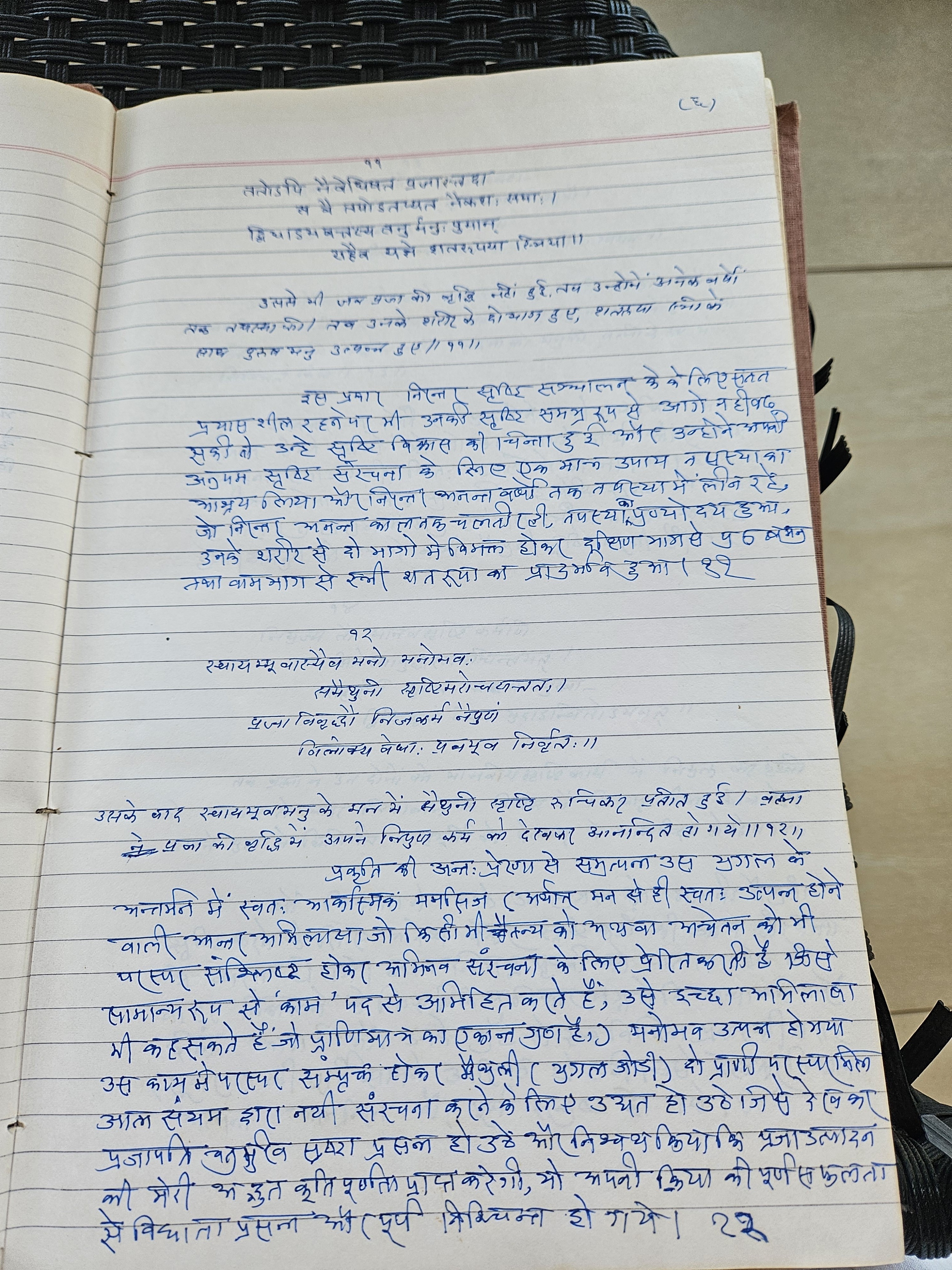
ततोऽपि नैवेधिषत प्रजास्तदा
स वै तपोऽतप्यत नैकशः समाः ।
द्विधाऽभवत्तस्य तनुर्मनुः पुमान्
स्त्रियैव जज्ञे शतरूपया स्त्रिया ॥ ११ ॥
Manuscript NoteAI-assisted transcription
वृत्त: वंशस्थ। पाद ४ का आरम्भ ("स्त्रियैव"/"सहैव") कुछ अस्पष्ट है। पूर्व पाठ "सोऽतात नेका समा शियाऽभवत्य / तनुमंडापुमान् सहेर यो शतरूपेण हिल्या" भ्रान्त था।
Manuscript Note (EN)AI-assisted transcription
Metre: Vaṃśastha. The start of pāda 4 ("स्त्रियैव"/"सहैव") is somewhat unclear. The earlier reading ("सोऽतात नेका समा शियाऽभवत्य / तनुमंडापुमान् सहेर यो शतरूपेण हिल्या") was wrong.
English Translation (of the Sanskrit)AI-assisted translation
Even then the creatures did not increase; so he practised austerity for many years. His body became twofold: Manu, the man, was born together with the woman Śatarūpā. (11)
Translationamanuensis's hand
उससे भी जब प्रजा की वृद्धि नहीं हुई, तब उन्होंने अनेक वर्षों तक तपस्या की। तब उनके शरीर के दो भाग हुए, शतरूपा स्त्री के साथ पुरुष मनु उत्पन्न हुए ॥ ११ ॥
English Translation (of the Hindi)AI-assisted translation
When even then the creatures did not increase, he practised austerity for many years. Then his body became two parts: the man Manu was born together with the woman Śatarūpā. (11)
Notesgrandfather's hand
इस प्रकार निरन्तर सृष्टि सञ्चालन के लिए सतत प्रयासशील रहने पर भी उनकी सृष्टि समग्र रूप से आगे नहीं बढ़ सकी तो उन्हें सृष्टि विकास की चिन्ता हुई और उन्होंने अपनी अनुपम सृष्टि संरचना के लिए एकमात्र उपाय तपस्या का आश्रय लिया और निरन्तर अनन्त वर्षों तक तपस्या में लीन रहे, जो निरन्तर अनन्त काल तक चलती रही, तपस्या का पुण्योदय हुआ, उनके शरीर से दो भागों में विभक्त होकर दक्षिण भाग से पुरुष मनु तथा वाम भाग से स्त्री शतरूपा का प्रादुर्भाव हुआ। ११
English NotesAI-assisted translation
Thus, although he kept striving constantly to run creation, his creation as a whole could not go forward; he became anxious about the growth of creation and, for making his matchless creation, took recourse to the one means, austerity, and remained absorbed in austerity for endless years. This went on for endless time; the merit of the austerity came to fruit, and his body divided into two parts: from the right part the man Manu appeared, and from the left part the woman Śatarūpā. (11)
Verse 12
Shlokamanuensis's hand
स्वायम्भुवस्यैव मनोर्मनोभवः
स मैथुनीं सृष्टिमरोचयत्ततः ।
प्रजाविवृद्धौ निजकर्मनैपुणं
विलोक्य वेधाः प्रबभूव निर्वृतः ॥ १२ ॥
Manuscript NoteAI-assisted transcription
वृत्त: वंशस्थ। पूर्व पाठ "स्वायम्भु बाह्येन मनो मनोमम् … विलोक्य येषाः प्रनभूल निर्माता" (पाद २ अनुपस्थित) भ्रान्त था।
Manuscript Note (EN)AI-assisted transcription
Metre: Vaṃśastha. The earlier reading ("स्वायम्भु बाह्येन मनो मनोमम् … विलोक्य येषाः प्रनभूल निर्माता", with pāda 2 missing) was wrong.
English Translation (of the Sanskrit)AI-assisted translation
Then Love (Manobhava), [arising] in Svāyambhuva Manu, made creation through union pleasing to him; seeing his own skill at work in the increase of creatures, the Creator became content. (12)
Translationamanuensis's hand
उसके बाद स्वायम्भुव मनु के मन में मैथुनी सृष्टि रुचिकर प्रतीत हुई। ब्रह्मा प्रजा की वृद्धि में अपने निपुण कर्म को देखकर आनन्दित हो गये ॥ १२ ॥
English Translation (of the Hindi)AI-assisted translation
After that, creation through union seemed pleasing in the mind of Svāyambhuva Manu. Seeing his own skilful work in the increase of creatures, Brahmā was glad. (12)
Notesgrandfather's hand
प्रकृति की अन्तःप्रेरणा से समुत्पन्न उस युगल के अन्तर्मन में स्वतः आकस्मिक मनसिज (अर्थात् मन से ही स्वतः उत्पन्न होने वाली अनन्त अभिलाषा जो किसी भी चैतन्य को अथवा अचेतन को भी परस्पर संश्लिष्ट होकर अभिनव संरचना के लिए प्रेरित करती है, जिसे सामान्य रूप से 'काम' पद से अभिहित करते हैं, उसे इच्छा, अभिलाषा भी कह सकते हैं जो प्राणिमात्र का एकान्त गुण है) मनोभव उत्पन्न हो गया, उस काम से परस्पर सम्पृक्त होकर मैथुनी (युगल जोड़ी) दो प्राणी परस्पर मिल आत्मसंयम द्वारा नयी संरचना करने के लिए उद्यत हो उठे, जिसे देखकर प्रजापति चतुर्मुख स्रष्टा प्रसन्न हो उठे और निश्चय किया कि प्रजा उत्पादन की मेरी अद्भुत कृति पूर्णता प्राप्त करेगी, यों अपनी क्रिया की पूर्ण सफलता से विधाता प्रसन्न और पूर्ण निश्चिन्त हो गये। १२
English NotesAI-assisted translation
In the inner mind of that couple, born of the inner prompting of Nature, there suddenly arose of itself Manobhava, "the mind-born" (that is, the endless longing that arises of itself from the mind and moves anything, conscious or unconscious, to join with another for a new creation; it is generally called by the word "kāma", and may also be called desire or longing; it is the one quality common to all creatures). Joined to each other through that desire, the two creatures, a couple, came together and, through self-restraint, became ready to make a new creation. Seeing this, Prajāpati, the four-faced creator, was pleased and decided that his wonderful work of producing creatures would reach completion; so, with the full success of his work, the Creator was pleased and wholly free of worry. (12)