Verse 51
Shlokamanuensis's hand
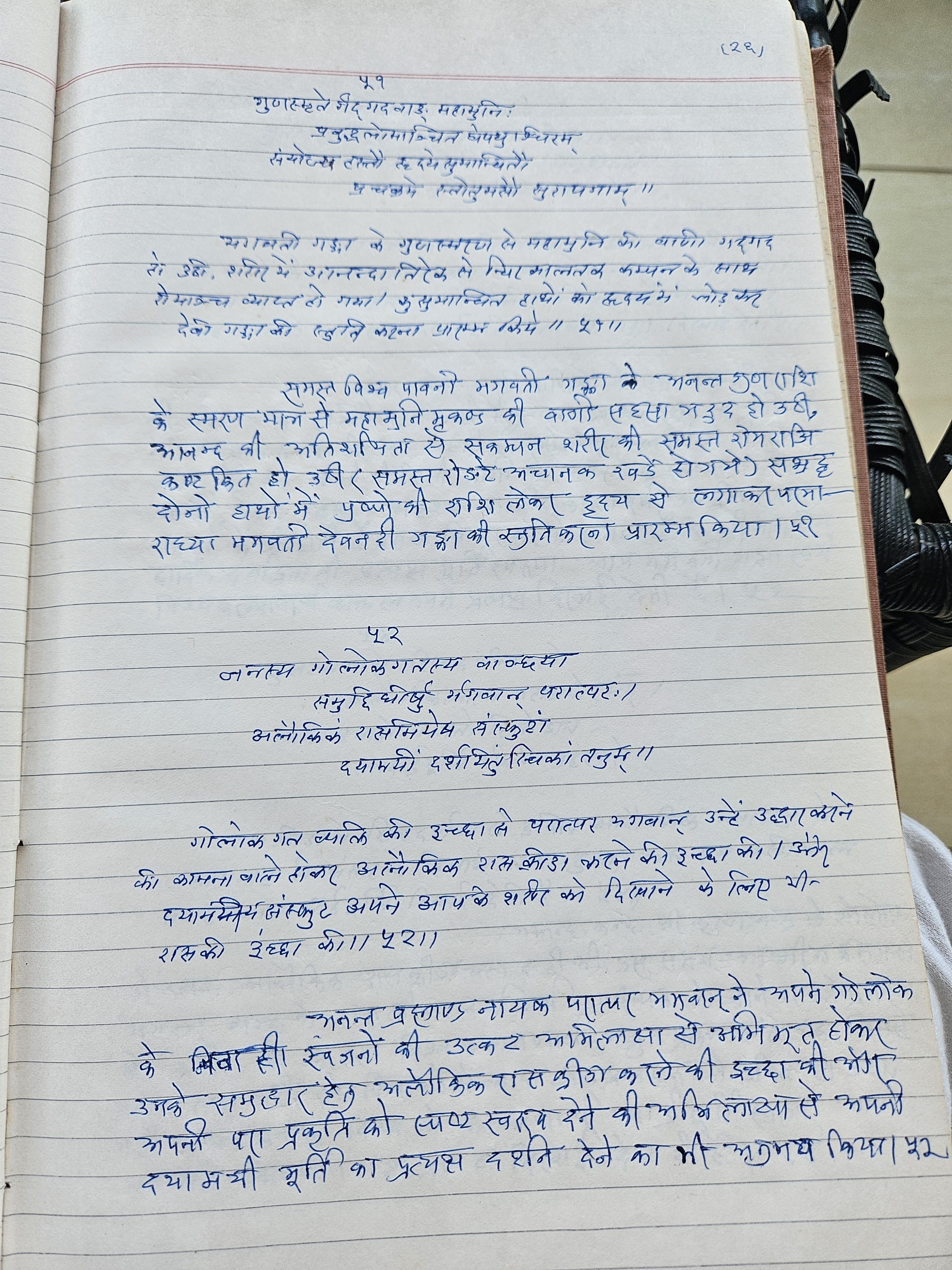
गुणस्मृतेर्गद्गदवाङ्महामुनिः
प्रबुद्धलोमाञ्चितवेपथुश्चिरम् ।
संयोज्य हस्तौ हृदये सुमान्वितौ
प्रचक्रमे स्तोतुमसौ सुरापगाम् ॥ ५१ ॥
Manuscript NoteAI-assisted transcription
वृत्त: उपजाति (पाद १, २, ४ वंशस्थ; पाद ३ इन्द्रवंशा)। पूर्व पाठ "गुणस्मृते … / … धेषयुश्चिरम् / संधोटस हानी हरये सुभावतो / … स्तोतुमथो…" भ्रान्त था।
Manuscript Note (EN)AI-assisted transcription
Metre: Upajāti (pādas 1, 2 and 4 Vaṃśastha; pāda 3 Indravaṃśā). The earlier reading ("गुणस्मृते … / … धेषयुश्चिरम् / संधोटस हानी हरये सुभावतो / … स्तोतुमथो…") was wrong.
English Translation (of the Sanskrit)AI-assisted translation
At the remembrance of her virtues the great sage's voice faltered; his hair stood on end and he trembled for a long while. Joining his flower-filled hands at his heart, he began to praise the river of the gods. (51)
Translationamanuensis's hand
यशस्वती गङ्गा के गुणस्मरण से महामुनि की वाणी गद्गद हो उठी, शरीर में आनन्दातिरेक से चिरकालतक कम्पन के साथ रोमाञ्च व्याप्त हो गया। कुसुमान्वित हाथों को हृदय में जोड़कर देवी गङ्गा की स्तुति करना प्रारम्भ किये ॥ ५१ ॥
English Translation (of the Hindi)AI-assisted translation
At the remembrance of the glorious Gaṅgā's virtues, the great sage's voice choked; from excess of joy, trembling and thrilling of the hair spread through his body for a long time. Joining his flower-filled hands at his heart, he began to praise the goddess Gaṅgā. (51)
Notesgrandfather's hand
समस्त विश्वपावनी भगवती गङ्गा के अनन्त गुणराशि के स्मरण मात्र से महामुनि मृकण्डु की वाणी सहसा गद्गद हो उठी, आनन्द की अतिशयिता से सकम्पन शरीर की समस्त रोमराजि कण्टकित हो उठी (समस्त रोंगटे अचानक खड़े हो गये) सश्रद्ध दोनों हाथों में पुष्पों की राशि लेकर हृदय से लगाकर परमाराध्या भगवती देवनदी गङ्गा की स्तुति करना प्रारम्भ किया। ५१
English NotesAI-assisted translation
At the mere remembrance of the endless virtues of the goddess Gaṅgā, who purifies the whole world, the great sage Mṛkaṇḍu's voice suddenly choked; from the excess of joy all the hair of his trembling body bristled (all his hair suddenly stood on end). With faith, taking heaps of flowers in both hands and holding them to his heart, he began to praise the most worshipful goddess, the divine river Gaṅgā. (51)
Verse 52
Shlokamanuensis's hand
जनस्य गोलोकगतस्य वाञ्छया
समुद्दिधीर्षुर्भगवान् परात्परः ।
अलौकिकं रासमियेष संस्फुटं
दयामयीं दर्शयितुं स्विकां तनुम् ॥ ५२ ॥
Manuscript NoteAI-assisted transcription
वृत्त: वंशस्थ (चारों पाद शुद्ध)। पूर्व पाठ "जनान् गोलोकगतस्य / … रासमियेष संयुगे / दयामयों…" भ्रान्त था।
Manuscript Note (EN)AI-assisted transcription
Metre: Vaṃśastha (all four pādas scan). The earlier reading ("जनान् गोलोकगतस्य / … रासमियेष संयुगे / दयामयों…") was wrong.
English Translation (of the Sanskrit)AI-assisted translation
At the longing of the folk who had gone to Goloka, the Lord beyond the highest, wishing to raise them up, desired the unearthly rāsa, so as to show plainly his own compassionate form. (52)
Translationamanuensis's hand
गोलोकगत व्यक्ति की इच्छा से परात्पर भगवान् उन्हें उद्धार करने की कामना वाले होकर अलौकिक रासक्रीडा करने की इच्छा की। और दयामयी संस्फुट अपने आपके शरीर को दिखाने के लिए भी रास की इच्छा की ॥ ५२ ॥
English Translation (of the Hindi)AI-assisted translation
At the wish of those who had gone to Goloka, the Lord beyond the highest, wishing to deliver them, desired to perform the unearthly rāsa play; and he desired the rāsa also in order to show his own compassionate body plainly. (52)
Notesgrandfather's hand
अनन्त ब्रह्माण्ड नायक परात्पर भगवान् ने अपने गोलोक के निवासी स्वजनों की उत्कट अभिलाषा से अभिभूत होकर अलौकिक रासक्रीडा करने की इच्छा की और उनके समुद्धार हेतु अपनी परा प्रकृति को स्पष्ट स्वरूप देने की अभिलाषा से अपनी दयामयी मूर्ति का प्रत्यक्ष दर्शन देने का भी [unclear: अनुभव] किया। ५२
English NotesAI-assisted translation
The Lord beyond the highest, master of endless universes, overcome by the ardent longing of his own people dwelling in Goloka, wished to perform the unearthly rāsa play; and, wishing to give his supreme nature a visible form for their deliverance, he also [unclear] to give them a direct sight of his compassionate figure. (52)