Verse 63
Shlokamanuensis's hand
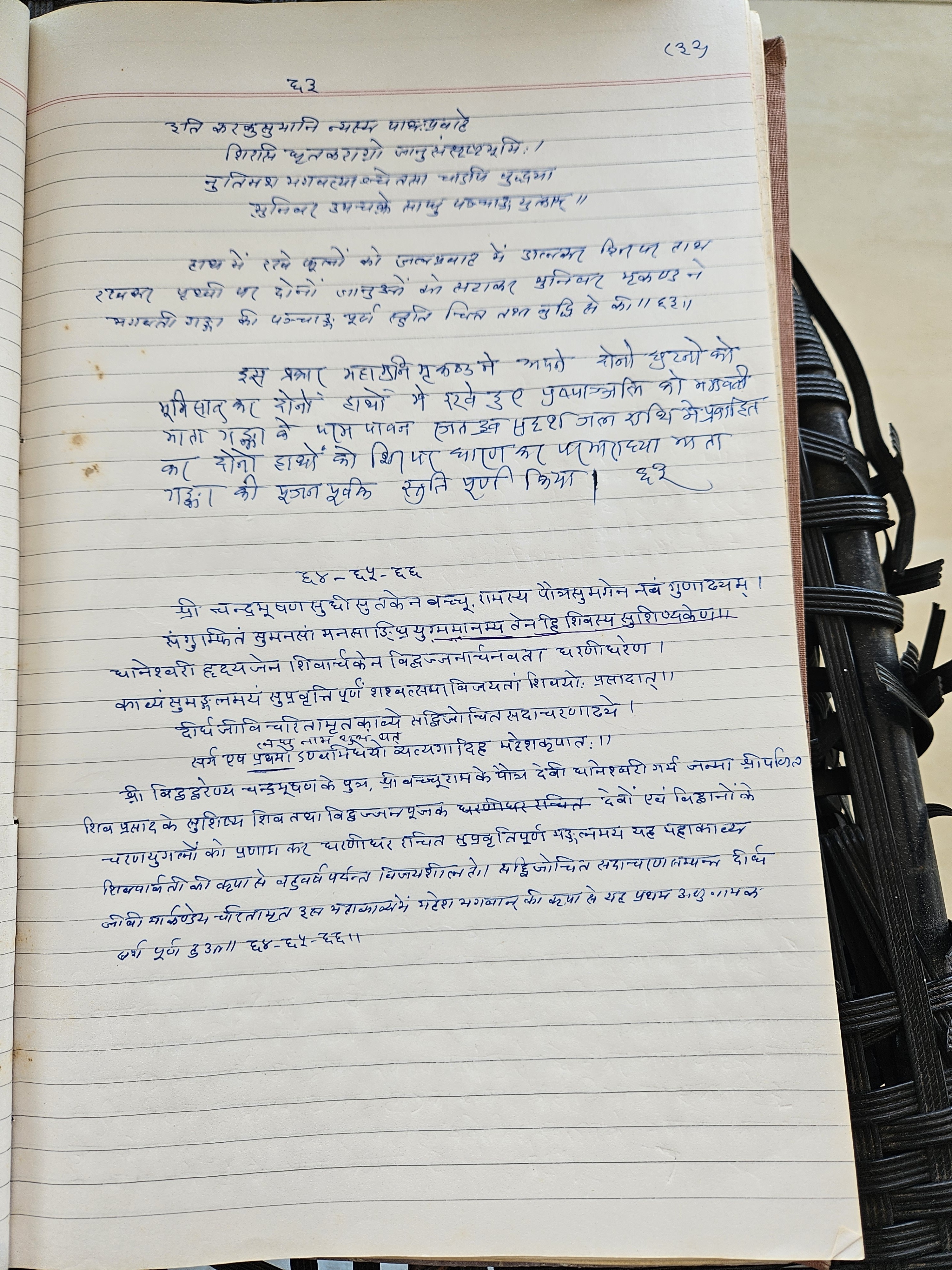
इति करकुसुमानि न्यस्य पाथःप्रवाहे
शिरसि धृतकराग्रो जानुसंस्पृष्टभूमिः ।
नुतिमथ भगवत्याश्चेतसा [unclear: चाऽऽर्द्र]बुद्ध्या
मुनिवर उपचक्रे साधु पञ्चाङ्गयुक्ताम् ॥ ६३ ॥
Manuscript NoteAI-assisted transcription
वृत्त: मालिनी (चारों पाद शुद्ध)। पाद ३ का "चाऽऽर्द्र" अनिश्चित है (अक्षर "चाऽऽद्रि" जैसे दिखते हैं)। पूर्व पाठ "पाशप्रवाहे / … चोद्धि बुद्ध्या / मुनिवर उमयत्के साधु पश्चाञ्चकार" भ्रान्त था।
Manuscript Note (EN)AI-assisted transcription
Metre: Mālinī (all four pādas scan). In pāda 3, "चाऽऽर्द्र" is uncertain (the letters look like "चाऽऽद्रि"). The earlier reading ("पाशप्रवाहे / … चोद्धि बुद्ध्या / मुनिवर उमयत्के साधु पश्चाञ्चकार") was wrong.
English Translation (of the Sanskrit)AI-assisted translation
Having thus placed the flowers from his hands in the flowing water, holding his fingertips to his head, his knees touching the ground, the excellent sage then duly offered the goddess a praise complete in its five limbs, with his mind and [unclear: tender] understanding. (63)
Translationamanuensis's hand
हाथ में रखे फूलों को जलप्रवाह में डालकर शिर पर हाथ रखकर पृथ्वी पर दोनों जानुओं को सटाकर मुनिवर मृकण्डु ने भगवती गङ्गा की पञ्चाङ्ग पूर्ण स्तुति चित्त तथा बुद्धि से की ॥ ६३ ॥
English Translation (of the Hindi)AI-assisted translation
Putting the flowers held in his hands into the stream of water, placing his hands on his head and pressing both knees to the earth, the excellent sage Mṛkaṇḍu offered the goddess Gaṅgā a praise complete in its five limbs, with mind and intellect. (63)
Notesgrandfather's hand
इस प्रकार महामुनि मृकण्डु ने अपने दोनों घुटनों को भूमिसात् कर दोनों हाथों में रखे हुए पुष्पाञ्जलि को भगवती माता गङ्गा के परम पावन [unclear] सदृश जल राशि में प्रवाहित कर दोनों हाथों को शिर पर धारण कर परमाराध्या माता गङ्गा की पूजनपूर्वक स्तुति पूर्ण किया। ६३
English NotesAI-assisted translation
Thus the great sage Mṛkaṇḍu, bringing both knees to the ground, let the handful of flowers in his two hands flow into the most holy, [unclear]-like waters of Mother Gaṅgā, placed both hands on his head, and completed the worship and praise of the most adorable Mother Gaṅgā. (63)
Verse 64-66
Shlokamanuensis's hand
श्रीचन्द्रभूषणसुधीसुतकेन बच्चू-
रामस्य पौत्रसुभगेन नवंगुणाढ्यम् ।
संगुम्फितं सुमनसां मनसाऽङ्घ्रियुग्म-
मानम्य तेन हि शिवस्य सुशिष्यकेण ॥ ६४ ॥
धानेश्वरीहृदयजेन शिवार्चकेन
विद्वज्जनार्चनरता धरणीधरेण ।
काव्यं सुमङ्गलमयं सुप्रवृत्तिपूर्णं
शश्वत् समा विजयतां शिवयोः प्रसादात् ॥ ६५ ॥
दीर्घजीविचरितामृतकाव्ये
सद्द्विजोचितसदाचरणाढ्ये ।
[unclear: सर्ग एष प्रथमोऽयमभिधेयो]
व्यत्यगादिह महेशकृपातः ॥ ६६ ॥
Manuscript NoteAI-assisted transcription
वृत्त: श्लोक ६४–६५ वसन्ततिलका, श्लोक ६६ स्वागता। पाण्डुलिपि में तीनों श्लोक लम्बी पंक्तियों में लिखे हैं; यहाँ पादों में विभक्त (पृष्ठ ११८ के समान)। श्लोक ६६ का तीसरा पाद अनिश्चित है: "सर्ग एष प्रथमोऽयमभिधेयो" लिखा है ("प्रथमो" रेखांकित, ऊपर पंक्तियों के बीच एक अस्पष्ट संशोधन), और यह पाठ स्वागता में नहीं बैठता। चौथा पाद "व्यत्यगादिह महेशकृपातः" शुद्ध है। पृष्ठ पर संस्कृत "इति … सर्गः समाप्तः" पुष्पिका-वाक्य नहीं है; पूर्व पाठ में वह जोड़ा गया था, अब हटाया गया।
Manuscript Note (EN)AI-assisted transcription
Metre: verses 64–65 Vasantatilakā, verse 66 Svāgatā. The manuscript writes the three verses in long lines; they are divided into pādas here (as on page 118). The third pāda of verse 66 is uncertain: it is written "सर्ग एष प्रथमोऽयमभिधेयो" ("प्रथमो" underlined, with an unclear interlinear correction above), and this reading does not scan as Svāgatā. The fourth pāda, "व्यत्यगादिह महेशकृपातः", scans. The page has no Sanskrit "इति … सर्गः समाप्तः" rubric; the earlier transcript had added one, and it has been removed.
English Translation (of the Sanskrit)AI-assisted translation
(64) By the son of the wise Śrī Candrabhūṣaṇa, the fortunate grandson of Baccū Rāma, this [poem], rich in the nine virtues, was woven, after bowing in his mind to the feet of the good-hearted, by that good disciple of Śiva. (65) By Dharaṇīdhara, born of the heart of Dhāneśvarī, worshipper of Śiva, devoted to honouring the learned: may this poem, full of auspiciousness and good purpose, be victorious for endless years by the grace of Śiva and Pārvatī. (66) In the poem "The Nectar of the Life of the Long-Lived", rich in the good conduct proper to good brahmins, [unclear: this first canto, so called,] has here come to its close by the grace of Maheśa.
Translationamanuensis's hand
श्री विद्वद्वरेण्य चन्द्रभूषण के पुत्र, श्री बच्चूराम के पौत्र देवी धानेश्वरी गर्भ जन्मा श्रीपण्डित शिव प्रसाद के सुशिष्य शिव तथा विद्वज्जनपूजक देवों एवं विद्वानों के चरणयुगलों को प्रणाम कर धरणीधर रचित सुप्रवृत्तिपूर्ण मङ्गलमय यह महाकाव्य शिवपार्वती की कृपा से बहुवर्ष पर्यन्त विजयशील हो। सद्द्विजोचित सदाचरणसम्पन्न दीर्घजीवी मार्कण्डेय चरितामृत इस महाकाव्य में महेश भगवान् की कृपा से यह प्रथम [unclear: अनुनामक] सर्ग पूर्ण हुआ ॥ ६४-६५-६६ ॥
English Translation (of the Hindi)AI-assisted translation
Composed by Dharaṇīdhara, son of the learned and excellent Śrī Candrabhūṣaṇa, grandson of Śrī Baccūrāma, born of the womb of the goddess Dhāneśvarī, good disciple of Śrī Paṇḍita Śiva Prasāda, honourer of Śiva and of the learned: having bowed to the pairs of feet of the gods and the learned, may this auspicious mahākāvya, full of good purpose, be victorious for many years by the grace of Śiva and Pārvatī. In this mahākāvya, "The Nectar of the Life of the Long-Lived Mārkaṇḍeya", rich in the good conduct proper to good brahmins, this first [unclear] canto is complete by the grace of Lord Maheśa. (64–66) [In the manuscript the words "धरणीधर रचित" first written after "विद्वज्जनपूजक" are struck out.]