Verse 24
Shlokamanuensis's hand
एवमादि हठयोगतत्परान्
राजयोगगतमानसानथ ।
स्वान्तरे परतरं समाधिभि-
र्ज्योतिरुज्ज्वलतरं व्यलोकयत् ॥ २४ ॥
English Translation (of the Sanskrit)AI-assisted translation
[He saw] these and other [sages] intent on haṭha yoga, and others whose minds were in rāja yoga, beholding within themselves, through samādhi, the highest, very bright light. (24)
Translationamanuensis's hand
ऐसे अनेक हठयोग में तल्लीन, कुछ राजयोग में मन लगाये हुए तथा किसी को समाधि के माध्यम से हृदयान्तर्गत दिव्य ज्योति का साक्षात्कार करते हुए उन्होंने देखा ॥ २४ ॥
English Translation (of the Hindi)AI-assisted translation
Thus he beheld various ascetics deeply devoted to Haṭha-yoga, others whose minds were absorbed in Rāja-yoga, and many beholding the transcendent, supremely effulgent Light within their inner self through states of deep meditative absorption (samādhi).
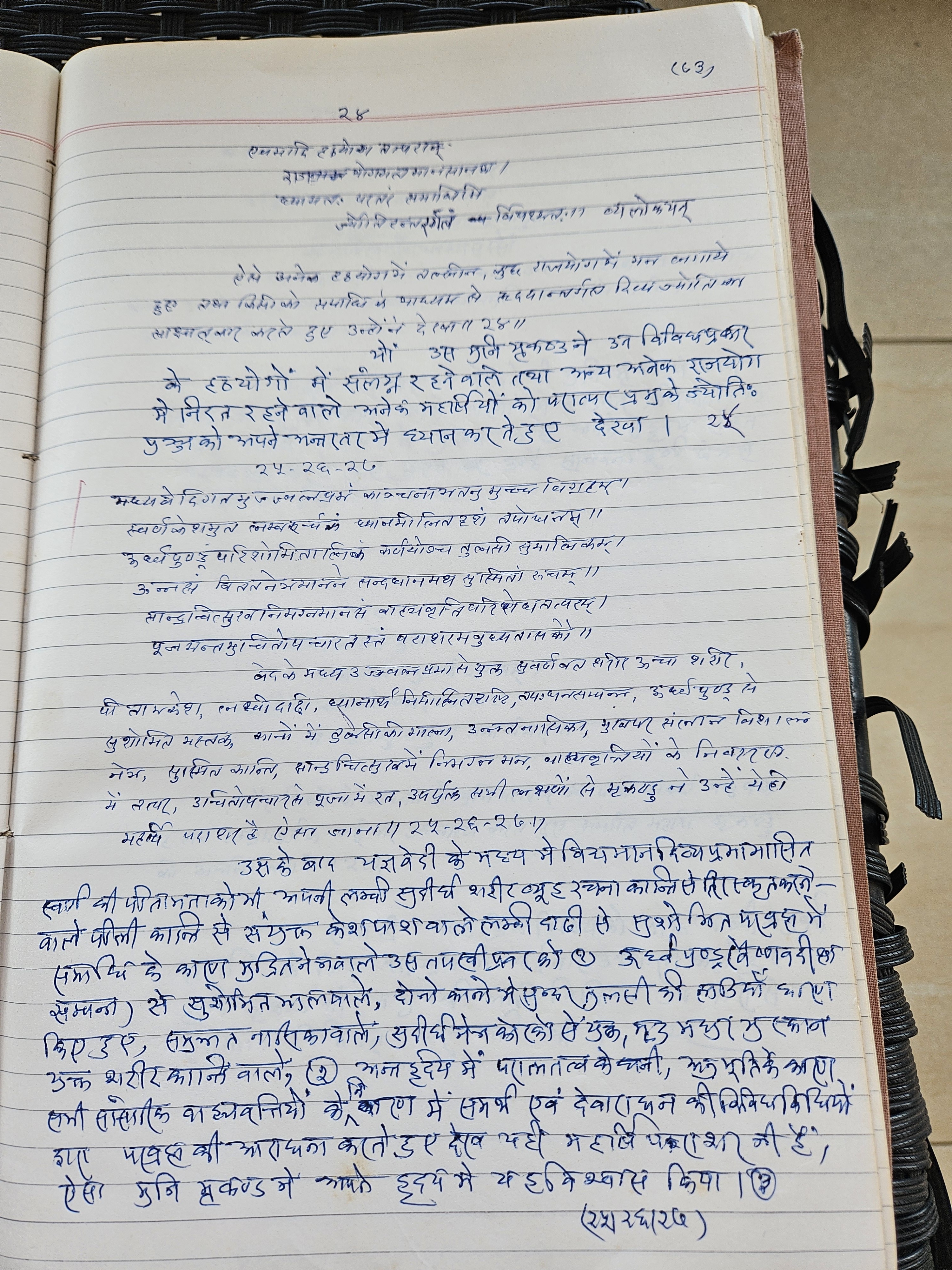
Notesgrandfather's hand
यों उस मुनि मृकण्ड ने उन विविध प्रकार के हठयोगों में संलग्न रहने वाले तथा अन्य अनेक राजयोग में निरत रहने वाले अनेक महर्षियों को परात्पर प्रभु के ज्योतिःपुञ्ज को अपने अन्तरात्मा में ध्यान करते हुए देखा । २४
English NotesAI-assisted translation
In this manner, Sage Mṛkaṇḍu observed many great seers engaged in diverse physical disciplines of Haṭha-yoga and others firmly established in contemplative Rāja-yoga, directly contemplating the effulgent mass of divine light of the Supreme Reality within their inmost consciousness.
Verse 25-27
Shlokamanuensis's hand
मध्यवेदिगतमुज्ज्वलप्रभं
काञ्चनाभतनुमुच्चविग्रहम् ।
स्वर्णकेशमुत लम्बकूर्चकं
ध्यानमीलितदृशं तपोधनम् ॥ २५ ॥
ऊर्ध्वपुण्ड्रपरिशोभितालिकं
कर्णयोश्च तुलसीसुमालिकम् ।
उन्नसं विततनेत्रमानने
सन्दधानमथ सुस्मितं रुचम् ॥ २६ ॥
सान्द्रचित्सुखनिमग्नमानसं
बाह्यवृत्तिपरिरोधतत्परम् ।
पूजयन्तमुचितोपचारत-
स्तं पराशरमबुध्यतासकौ ॥ २७ ॥
Manuscript NoteAI-assisted transcription
वृत्त: रथोद्धता। पाण्डुलिपि में तीनों श्लोक लम्बी पंक्तियों में लिखे हैं। सुधार: "मध्यवेदि…" (पूर्व "मध्येवेदि…"), "स्वर्णकेशमुत" (पूर्व "…मथ"), "उन्नसं विततनेत्रमानने" (पूर्व "उन्नसं किञ्चिन्नियममानने" छन्द में नहीं बैठता था), "सुस्मितं रुचम्", "मबुध्यतासकौ" (पूर्व "मबुध्यताग्रतः")।
Manuscript Note (EN)AI-assisted transcription
Metre: Rathoddhatā. The manuscript writes the three verses in long lines. Corrections: "मध्यवेदि…" (earlier "मध्येवेदि…"), "स्वर्णकेशमुत" (earlier "…मथ"), "उन्नसं विततनेत्रमानने" (the earlier "उन्नसं किञ्चिन्नियममानने" did not scan), "सुस्मितं रुचम्", and "मबुध्यतासकौ" (earlier "मबुध्यताग्रतः").
English Translation (of the Sanskrit)AI-assisted translation
(25) In the middle of the altar, of bright splendour, his body golden in hue, tall in form, with golden hair and a long beard, his eyes closed in meditation, rich in austerity; (26) his forehead adorned with the upright mark (ūrdhvapuṇḍra), with fine tulasī garlands at his ears, high-nosed, [unclear] on his face, bearing the light of a gentle smile; (27) his mind sunk in the dense joy of consciousness, intent on restraining outward activity, worshipping with fitting offerings: Parāśara he recognised before him. (25-27)
Translationamanuensis's hand
वेदी के मध्य उज्ज्वल प्रभा से युक्त सुवर्णवत् शरीर, ऊंचा शरीर, पीला केश, लम्बी दाढ़ी, ध्यानार्थ निमीलित दृष्टि, तपोबलसम्पन्न, ऊर्ध्वपुण्ड्र से सुशोभित मस्तक, कानों में तुलसी की माला, उन्नत नासिका, मुख पर संलग्न विशाल नेत्र, सुस्मित कान्ति, सान्द्रचित्सुख में निमग्न मन, बाह्यवृत्तियों के निवारण में तत्पर, उचितोपचार से पूजा में रत, उपर्युक्त सभी लक्षणों से मृकण्डु ने उन्हें यही महर्षि पराशर हैं ऐसा जाना ॥ २५-२६-२७ ॥
English Translation (of the Hindi)AI-assisted translation
Seated in the midst of the sacrificial altar, shining with dazzling radiance, possessing a tall frame of golden complexion, with golden hair and a long flowing beard, his eyes gently closed in meditation, rich in the wealth of penance; His forehead adorned with the auspicious vertical mark (ūrdhvapuṇḍra), his ears graced with delicate strands of sacred tulasī, endowed with a noble aquiline nose, bearing on his face a soft, enchanting smile; His consciousness deeply immersed in the dense nectar of spiritual bliss (cit-sukha), wholly restraint of all outward sensory modifications, and offering divine worship with fitting ceremonial rites—perceiving all these sacred marks, Mṛkaṇḍu recognized before him the venerable Sage Parāśara!
Notesgrandfather's hand
उसके बाद यज्ञवेदी के मध्य में विद्यमान दिव्य प्रभा भासित स्वर्ण की पीताभता को भी अपनी लम्बी सुदीर्घ शरीर व्यूह रचना कान्ति से तिरस्कृत करने वाले पीली कान्ति से संयुक्त केशपाश वाले लम्बी दाढ़ी से सुशोभित प्रत्यक्ष में समाधि के कारण मुद्रित नेत्र वाले उस तपस्वी प्रवर को १. ऊर्ध्वपुण्ड्र (वैष्णव दीक्षा सम्पन्न) से सुशोभित भाल वाले, दोनों कानों में सुन्दर तुलसी की लड़ियाँ धारण किए हुए, समुन्नत नासिका वाले, सुदीर्घ नेत्र कोनों से युक्त, मृदु मधुर मुस्कान युक्त शरीर कान्ति वाले, २. अन्तर्हृदय में परात्तत्व के ध्यानी, अनुभूतियों के कारण सभी सांसारिक बाह्यवृत्तियों के निरोध करने में समर्थ एवं देवाराधन की विविध विधियों द्वारा परब्रह्म की आराधना करते हुए देख यही महर्षि पराशर जी हैं, ऐसा मुनि मृकण्ड ने अपने हृदय में यह विश्वास किया । (२५, २६, २७)
English NotesAI-assisted translation
After this, [he saw] that excellent ascetic in the middle of the sacrificial altar, shining with divine splendour, whose tall body and grace of form outshone even the yellow glow of gold, with hair of yellow lustre, adorned with a long beard, his eyes closed because of samādhi: (1) his forehead adorned with the ūrdhvapuṇḍra (having received Vaiṣṇava initiation), wearing lovely strands of tulasī in both ears, with a high nose and long corners to his eyes, his bodily lustre joined with a soft, sweet smile; (2) meditating within his heart on the highest reality, able, through his experiences, to restrain all outward worldly activity, and worshipping the Supreme Brahman by various methods of worship of the gods. Seeing him, the sage Mṛkaṇḍa was convinced in his heart: "This is Maharṣi Parāśara." (25, 26, 27)