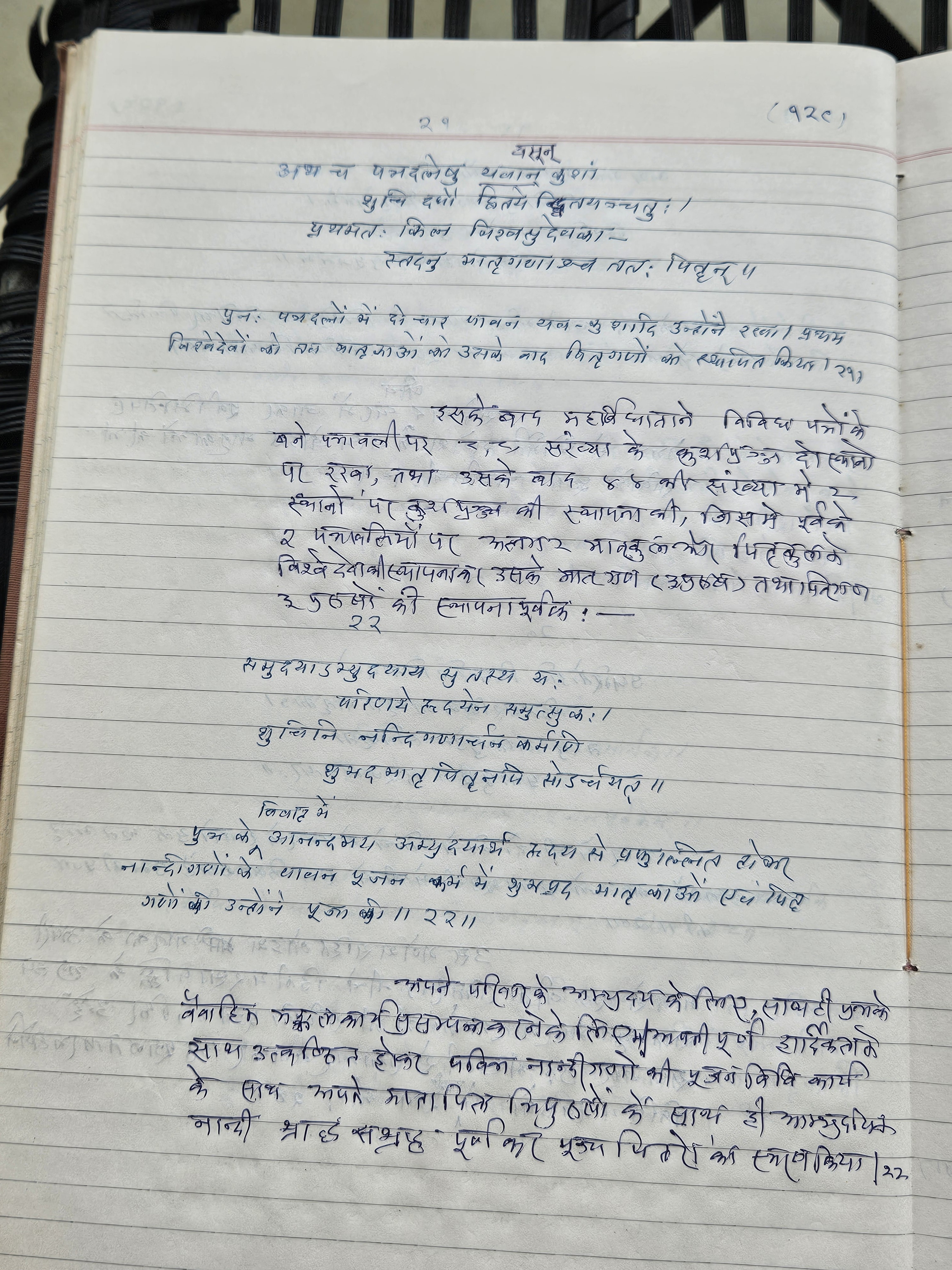
Verse 21
Shlokamanuensis's hand
अथ च पत्रदलेषु यवान्कुशां-
शुचि दधौ द्वितये द्वितयं चतुः ।
प्रथमतः किल विश्वसुदेवका-
स्तदनु मातृगणांश्च ततः पितॄन् ॥ २१ ॥
Manuscript NoteAI-assisted transcription
वृत्त: द्रुतविलम्बित। पाद १: "यवान्" के ऊपर "यसून्"/"प्रसून्" जैसा शब्द लिखा है और "यवान्" के नीचे रेखा है (संशोधन या पाठान्तर?)। पाद २: "द्वितये" के बाद एक अक्षर काटकर "द्वितयञ्चतुः" लिखा है; "द्वितयं चतुः" पढ़ा गया (टिप्पणी: २, २ और ४, ४ कुशपुञ्ज)।
Manuscript Note (EN)AI-assisted transcription
Metre: Drutavilambita. Pāda 1: above "यवान्" a word like "यसून्"/"प्रसून्" is written, and "यवान्" is underlined (a correction or a variant?). Pāda 2: after "द्वितये" a letter is struck out and "द्वितयञ्चतुः" written; read as "द्वितयं चतुः" (the notes: bundles of kuśa in twos and fours).
English Translation (of the Sanskrit)AI-assisted translation
And then on leaf-plates he placed pure barley and kuśa, in two places, two and four; first the Viśvedevas, then the hosts of Mothers, and then the Fathers. (21)
Translationamanuensis's hand
पुनः पत्रदलों में दो चार पावन यव-कुशादि उन्होंने रखा। प्रथम विश्वेदेवों को तब मातृकाओं को उसके बाद पितृगणों को स्थापित किया। २१।
English Translation (of the Hindi)AI-assisted translation
Then on leaf-plates he placed two and four [bundles of] pure barley, kuśa and the like. First he installed the Viśvedevas, then the Mothers, and after that the hosts of Fathers. (21)
Notesgrandfather's hand
इसके बाद महर्षि धाता ने विविध पत्रों के बने पत्रावली पर २, २ संख्या के कुशपुञ्ज दो स्थानों पर रखा, तथा उसके बाद ४ ४ की संख्या में २ स्थानों पर कुशपुञ्ज की स्थापना की, जिसमें पूर्व के २ पत्रावलियों पर अलग अलग मातृकुल और पितृकुल के विश्वेदेवा की स्थापना कर उसके मातृगण (३ पुरुष) तथा पितृगण ३ पुरुषों की स्थापनापूर्वक :—
English NotesAI-assisted translation
After this the great sage Dhātā, on leaf-plates made of various leaves, placed bundles of kuśa two by two in two places, and after that installed bundles of kuśa four by four in two places. On the first two leaf-plates he installed the Viśvedevas of the mother's line and of the father's line separately, and then, having installed its hosts of Mothers (three generations) and hosts of Fathers (three generations):— (21)
Verse 22
Shlokamanuensis's hand
समुदयाऽभ्युदयाय सुतस्य यः
परिणये हृदयेन समुत्सुकः ।
शुचिनि नन्दिगणार्चनकर्मणि
शुभदमातृपितॄनपि सोऽर्चयत् ॥ २२ ॥
Manuscript NoteAI-assisted transcription
वृत्त: द्रुतविलम्बित। पाद ३: लिखा "नन्दि" (हिन्दी: "नान्दीगणों"); छन्द दोनों पाठों में ठीक।
Manuscript Note (EN)AI-assisted transcription
Metre: Drutavilambita. Pāda 3: written "नन्दि" (the Hindi has "नान्दीगणों"); either reading scans.
English Translation (of the Sanskrit)AI-assisted translation
He who, eager at heart for his son's marriage, sought joy and prosperity for him, in the pure rite of worshipping the Nāndī hosts worshipped also the auspicious Mothers and Fathers. (22)
Translationamanuensis's hand
पुत्र के [ऊपर जोड़ा: विवाह में] आनन्दमय अभ्युदयार्थ हृदय से प्रफुल्लित होकर नान्दीगणों के पावन पूजन ~~कर्म~~ कर्म में शुभप्रद मातृकाओं एवं पितृगणों की उन्होंने पूजा की ॥ २२ ॥
English Translation (of the Hindi)AI-assisted translation
Heart blossoming for the joyful prosperity of his son [added above: in the marriage], in the pure rite of worshipping the Nāndī hosts he worshipped the auspicious Mothers and the hosts of Fathers. (22)
Notesgrandfather's hand
अपने [unclear: परिवार] के अभ्युदय के लिए, साथ ही पुत्र के वैवाहिक मङ्गल कार्य सुसम्पन्न करने के लिए [unclear: भावभरी] पूर्ण हार्दिकता के साथ उत्कण्ठित होकर पवित्र नान्दीगणों की पूजन विधि कार्य के साथ अपने माता पिता त्रिपुरुषों के साथ ही आभ्युदयिक नान्दी श्राद्ध [unclear: सम्पन्न] पूर्वक पूज्य पितरों का स्मरण किया । २२
English NotesAI-assisted translation
For the prosperity of his [unclear: family], and also to bring his son's auspicious wedding to a fine completion, eager and with [unclear: heartfelt] sincerity, along with the rite of worshipping the holy Nāndī hosts, he remembered the revered Fathers, by way of [unclear: performing] the ābhyudayika Nāndī-śrāddha, together with three generations on his mother's and father's sides. (22)