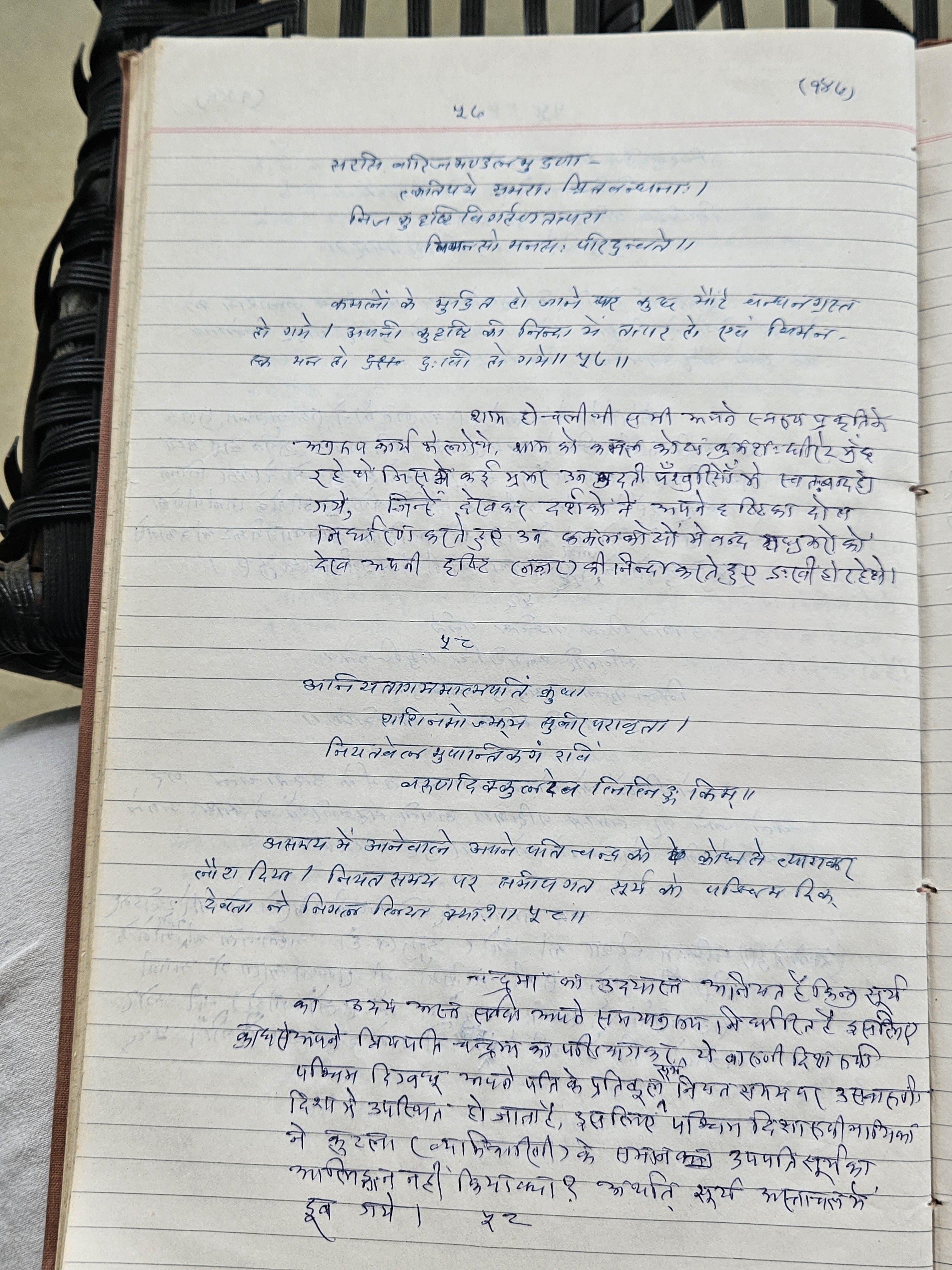
Verse 57
Shlokamanuensis's hand
सरसि वारिजमण्डलमुद्रणा-
त्कतिपये भ्रमराः प्रतिबन्धनाः ।
निजकुदृष्टिविगर्हणतत्पराः
विमनसो मनसः परिदुन्वते ॥ ५७ ॥
Manuscript NoteAI-assisted transcription
वृत्त: द्रुतविलम्बित। चारों पाद लिखित रूप में छन्द में बैठते हैं। पाद ३: अन्त में विसर्ग धुँधला ("तत्परा")। पाद ४: "परिदुन्वते" (√दु, दुःखी होना) जैसा पढ़ा गया; हिन्दी "विमनस्क मन से दुःखी हो गये"।
Manuscript Note (EN)AI-assisted transcription
Metre: Drutavilambita. All four pādas scan as written. Pāda 3: the final visarga is faint ("तत्परा"). Pāda 4: read as "परिदुन्वते" (√du, to grieve); the Hindi has "they grew sad, downcast at heart".
English Translation (of the Sanskrit)AI-assisted translation
As the clusters of lotuses closed on the lake, some bees were caught inside; blaming their own poor sight, they grieve, downcast at heart. (57)
Translationamanuensis's hand
कमलों के मुद्रित हो जाने पर कुछ भौंरे बन्धनग्रस्त हो गये । अपनी कुदृष्टि की निन्दा में तत्पर हो एवं विमनस्क मन से दुःखी हो गये ॥ ५७ ॥
English Translation (of the Hindi)AI-assisted translation
When the lotuses closed, some bees were caught. Intent on blaming their own poor sight, they grew sad and downcast. (57)
Notesgrandfather's hand
शाम हो चली थी सभी अपने स्वभाव प्रकृति के अनुरूप कार्य में लगे थे, शाम को कमल कोष क्रमशः धीरे धीरे मुंद रहे थे जिससे कई भ्रमर उन मुंदती पंखुड़ियों में बन्द हो गये, जिन्हें देखकर दर्शकों ने अपने दृष्टि का दोष निर्धारण करते हुए उन कमलकोषों में बन्द मधुकरों को देख अपनी दृष्टि (नजर) की निन्दा करते हुए दुःखी हो रहे थे ।
English NotesAI-assisted translation
Evening was coming on, and everyone was busy with work suited to their own nature. In the evening the lotus-cups were slowly closing one by one, so that several bees were shut inside those closing petals. Seeing them, the onlookers, judging it a fault of their own sight, looked at the bees shut in those lotus-cups and were sad, blaming their own sight (their eye).
Verse 58
Shlokamanuensis's hand
अनियतागममात्मपतिं क्रुधा
शशिनमुज्झ्य [unclear: सुदूरपरावृता] ।
नियतवेलमुपान्तिकगं रविं
वरुणदिक्कुलटेव लिलिङ्ग किम् ॥ ५८ ॥
Manuscript NoteAI-assisted transcription
वृत्त: द्रुतविलम्बित। पाद १, ३, ४ लिखित रूप में छन्द में बैठते हैं। पाद २: लिखित "शशिनमोज्झ्य" (व्याकरण से "शशिनमुज्झ्य"); उसके बाद "सु?रपरावृता" — बीच का अक्षर "तो"/"को"/"दू" जैसा; "सुदूरपरावृता" छन्द (।ऽ।।ऽ।ऽ) में बैठता है, पर अनिश्चित। पाद ४: "कुलटेव" — टिप्पणी "कुलटा (व्यभिचारिणी) के समान" से पुष्ट।
Manuscript Note (EN)AI-assisted transcription
Metre: Drutavilambita. Pādas 1, 3 and 4 scan as written. Pāda 2: written "शशिनमोज्झ्य" (grammatically "शशिनमुज्झ्य"); then "सु?रपरावृता", where the middle letter looks like "तो"/"को"/"दू"; "सुदूरपरावृता" scans (।ऽ।।ऽ।ऽ) but is uncertain. Pāda 4: "कुलटेव" is confirmed by the note ("like a kulaṭā, an unchaste woman").
English Translation (of the Sanskrit)AI-assisted translation
Having in anger cast off her own husband the moon, whose coming is irregular, and turned [far] away, did the western quarter, like an unchaste woman, embrace the sun, who comes near at a fixed hour? (58)
Translationamanuensis's hand
असमय में आने वाले अपने पति चन्द्र को क्रोध से त्यागकर लौटा दिया । नियत समय पर समीपगत सूर्य को पश्चिम दिक् देवता ने निगल लिया क्या ? ॥ ५८ ॥
English Translation (of the Hindi)AI-assisted translation
In anger she cast off and sent back her husband the moon, who comes at irregular times. Did the deity of the western quarter swallow the sun, who drew near at the fixed time? (58)
Notesgrandfather's hand
चन्द्रमा का उदयास्त अनियत है किन्तु सूर्य का उदय अस्त सर्वदा अपने समय पर [unclear: समयबद्ध] निर्धारित है इसलिए क्रोध से अपने विधिपति चन्द्रमा का परित्याग कर, ये वारुणी दिशा रूपी पश्चिम दिग्वधू — अपने पति के प्रतिकूल सूर्य नियत समय पर उस वारुणी दिशा में उपस्थित हो जाता है, इसलिए पश्चिम दिशा रूपी नायिका ने कुलटा (व्यभिचारिणी) के समान उपपति सूर्य का आलिङ्गन नहीं किया क्या ? अर्थात् सूर्य अस्ताचल में डूब गये । ५८
English NotesAI-assisted translation
The moon's rising and setting are irregular, but the sun's rising and setting are always fixed to their own time. So, in anger, this bride of the western quarter, the direction of Varuṇa, cast off her lawful husband the moon; and the sun, unlike her husband, arrives in that western quarter at the fixed time. So did not the heroine, the western quarter, like an unchaste woman (an adulteress), embrace her paramour the sun? That is, the sun sank behind the western mountain. (58)