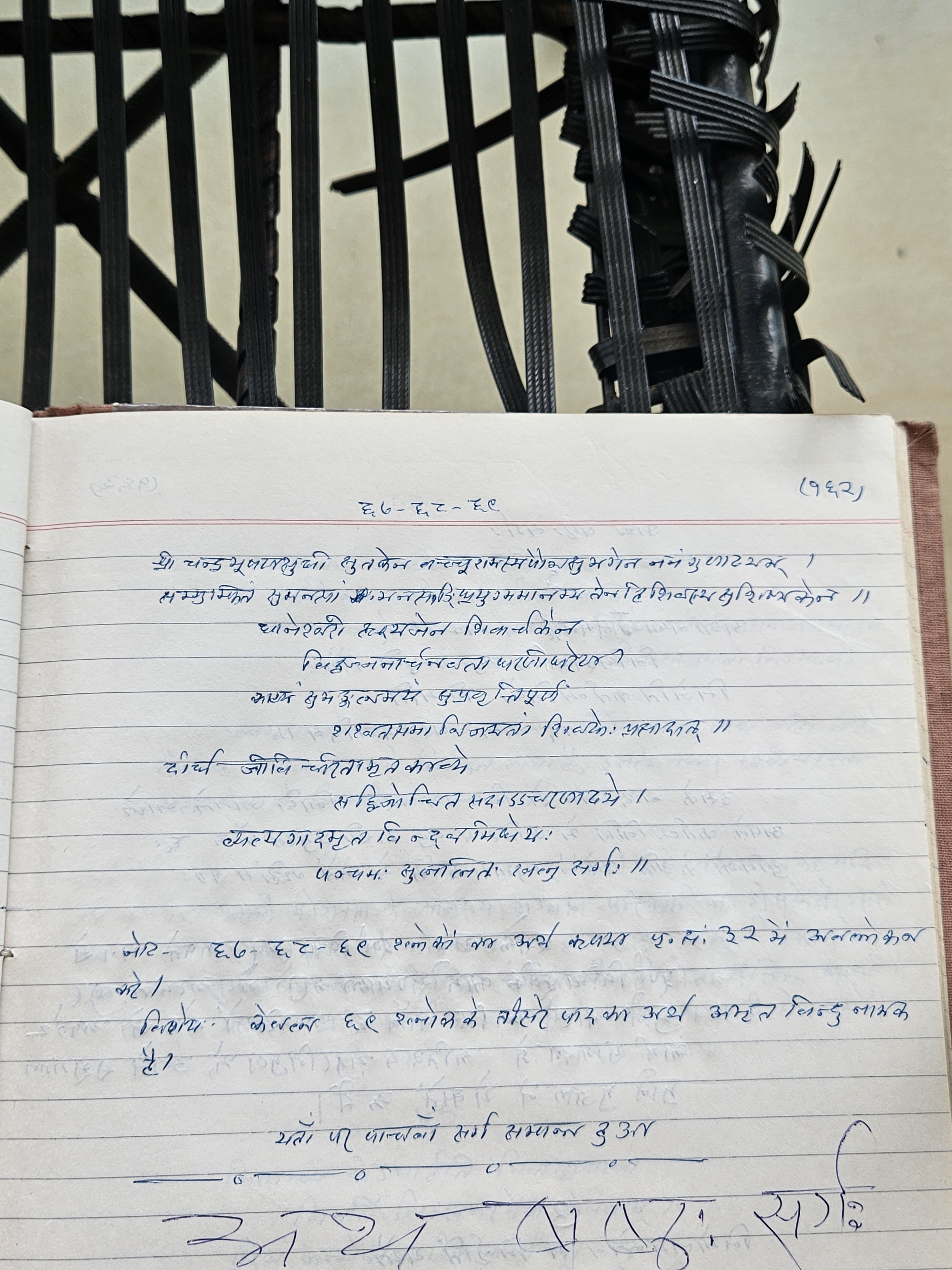
Verse 67-69
Shlokamanuensis's hand
श्रीचन्द्रभूषणसुधीसुतकेन बच्चू-
रामस्य पौत्रसुभगेन नवंगुणाढ्यम् ।
संगुम्फितं सुमनसां मनसाऽङ्घ्रियुग्म-
मानम्य तेन हि शिवस्य सुशिष्यकेण ॥ ६७ ॥
धानेश्वरीहृदयजेन शिवार्चकेन
विद्वज्जनार्चनरता धरणीधरेण ।
काव्यं सुमङ्गलमयं सुप्रवृत्तिपूर्णं
शश्वत्समा विजयतां शिवयोः प्रसादात् ॥ ६८ ॥
दीर्घजीविचरितामृतकाव्ये
सद्द्विजोचितसदाऽऽचरणाढ्ये ।
[unclear: अत्यगादमृतबिन्दुरिवैषः]
पञ्चमः सुललितः खलु सर्गः ॥ ६९ ॥
Manuscript NoteAI-assisted transcription
वृत्त: श्लोक ६७-६८ वसन्ततिलका, श्लोक ६९ स्वागता। यह पुष्पिका-त्रयी पृष्ठ ३२, ६०, ८६ और ११८ की त्रयी के समान है; यहाँ पाठ इसी पृष्ठ से पढ़ा गया और ११८ से मिलाया गया। शीर्षक "६७-६८-६९"। श्लोक ६७ पाद ३: "सुमनसां" के बाद एक अक्षर कटा हुआ है। श्लोक ६९ पाद ३ (इस सर्ग का अपना पाद, जिसका अर्थ लिपिकार के "विशेष" में "अमृत बिन्दु" बताया गया है): "अत्यगादमृतबिन्दुरिवैषः" जैसा पढ़ा गया ("यह अमृत की बूँद की तरह बीत गया"); पहला शब्द "अत्यगात्"/"अल्पगात्" — छन्द में दोनों बैठते हैं, पर पाठ अनिश्चित। पृष्ठ पर संस्कृत "इति ... सर्गः समाप्तः" पुष्पिका-वाक्य नहीं है। "यहाँ पर पाँचवाँ सर्ग समाप्त हुआ" के नीचे वृत्ताकार चिह्नों वाली समापन-रेखा है, और उसके नीचे बड़े अक्षरों में "अथ षष्ठः सर्गः" — यह छठे सर्ग का शीर्षक है, पाँचवें का अंश नहीं।
Manuscript Note (EN)AI-assisted transcription
Metre: verses 67–68 Vasantatilakā, verse 69 Svāgatā. This colophon triad matches the triads on pages 32, 60, 86 and 118; here it was read from this page and checked against page 118. The heading is "६७-६८-६९". Verse 67 pāda 3: a letter after "सुमनसां" is struck out. Verse 69 pāda 3 (the pāda proper to this canto, which the amanuensis's "विशेष" glosses as "amṛta bindu", a drop of nectar) is read as "अत्यगादमृतबिन्दुरिवैषः" ("this passed like a drop of nectar"); the first word could be "अत्यगात्" or "अल्पगात्", both of which scan, so the reading is uncertain. The page has no Sanskrit "इति ... सर्गः समाप्तः" rubric. Below "यहाँ पर पाँचवाँ सर्ग समाप्त हुआ" is a closing rule with small circles, and below that, in large letters, "अथ षष्ठः सर्गः": the heading of canto 6, not part of canto 5.
English Translation (of the Sanskrit)AI-assisted translation
(67) By the son of the wise Śrī Candrabhūṣaṇa, the fortunate grandson of Baccū Rāma, this [poem], rich in the nine virtues, was woven, after bowing in his mind to the feet of the good-hearted, by that good disciple of Śiva. (68) By Dharaṇīdhara, born of the heart of Dhāneśvarī, worshipper of Śiva, devoted to honouring the learned: may this poem, full of auspiciousness and good purpose, be victorious for endless years by the grace of Śiva and Pārvatī. (69) In the poem "The Nectar of the Life of the Long-Lived", rich in the good conduct proper to good brahmins, this charming fifth canto [unclear: has passed like a drop of nectar].
Translationamanuensis's hand
नोट — ६७-६८-६९ श्लोकों का अर्थ कृपया पृ. सं. ३२ में अवलोकन करें ।
विशेष: केवल ६९ श्लोक के तीसरे पाद का अर्थ अमृत बिन्दु नामक है ।
यहाँ पर पाँचवाँ सर्ग समाप्त हुआ ।
English Translation (of the Hindi)AI-assisted translation
Note: for the meaning of verses 67–69, please see page 32.
Special note: only the third pāda of verse 69 has a [different] meaning, named "amṛta bindu" (a drop of nectar).
Here the fifth canto is complete.