Verse 15
Shlokamanuensis's hand
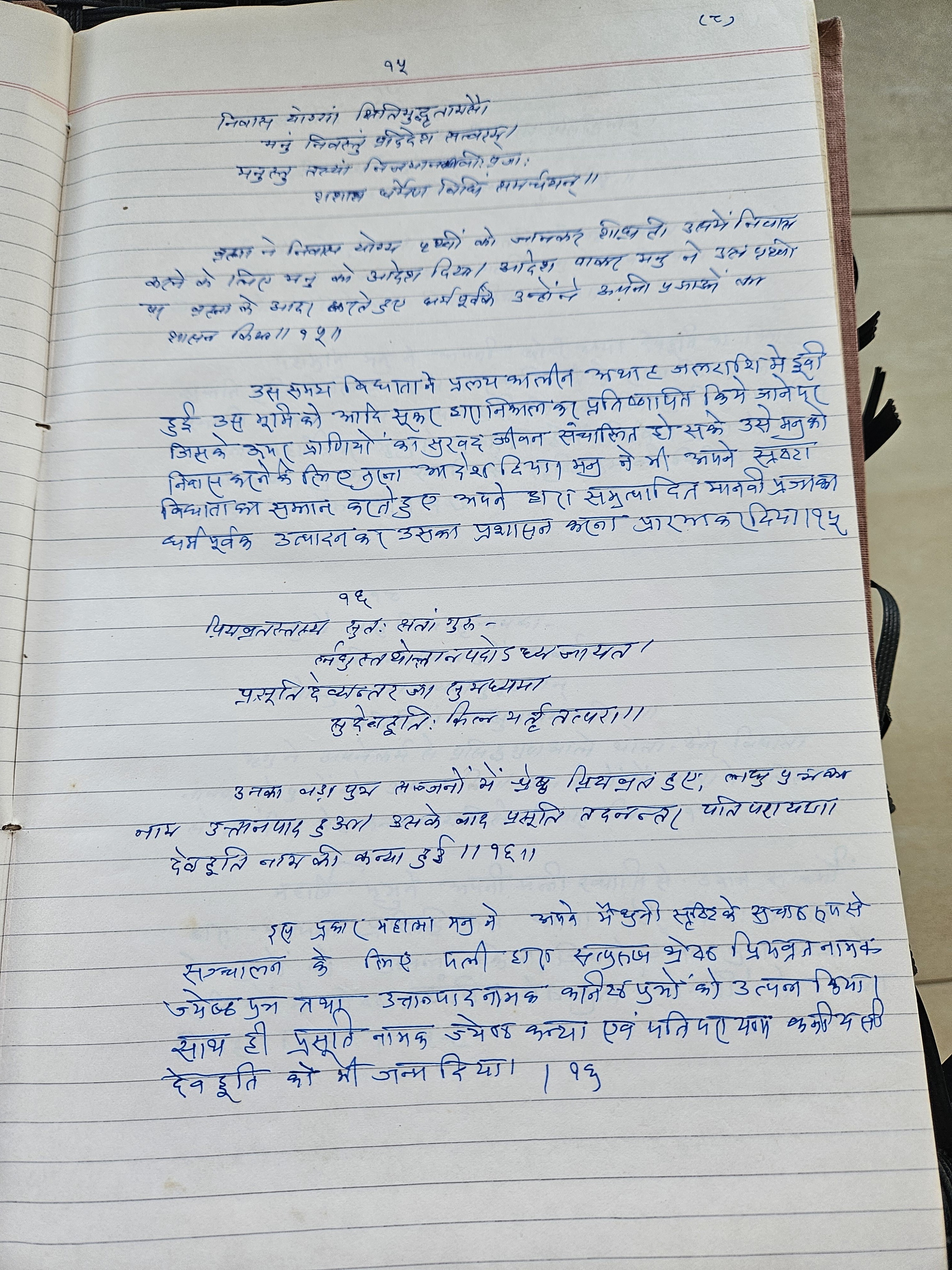
निवासयोग्यां क्षितिमुद्धृतामसौ
मनुं निवस्तुं प्रदिदेश सत्वरम् ।
मनुस्तु तस्यां निजभावितोः प्रजाः
शशास धर्मेण विधिं समर्चयन् ॥ १५ ॥
Manuscript NoteAI-assisted transcription
वृत्त: वंशस्थ। पाद ३ का "निजभावितोः" अंश कुछ अस्पष्ट है। पूर्व पाठ "निरास योग्या क्षितियुद्धतायो / मनुं विलम्बु … मनुस्तु तत्तो निजकाममोक्षजाः / शकास लोकैन विविध समेधनाम्" भ्रान्त था।
Manuscript Note (EN)AI-assisted transcription
Metre: Vaṃśastha. The part "निजभावितोः" of pāda 3 is somewhat unclear. The earlier reading ("निरास योग्या क्षितियुद्धतायो / मनुं विलम्बु … मनुस्तु तत्तो निजकाममोक्षजाः / शकास लोकैन विविध समेधनाम्") was wrong.
English Translation (of the Sanskrit)AI-assisted translation
He quickly directed Manu to dwell on the earth that had been raised up and was fit to live on; and Manu, honouring the Creator, ruled with dharma the creatures he himself had brought forth on it. (15)
Translationamanuensis's hand
ब्रह्मा ने निवासयोग्य पृथ्वी को जानकर शीघ्र ही उसमें निवास करने के लिए मनु को आदेश दिया। आदेश पाकर मनु ने उस पृथ्वी पर ब्रह्मा के आदर करते हुए धर्मपूर्वक उन्होंने अपनी प्रजाओं का शासन किया ॥ १५ ॥
English Translation (of the Hindi)AI-assisted translation
Knowing the earth to be fit to live on, Brahmā quickly ordered Manu to dwell on it. Receiving the order, Manu, honouring Brahmā, ruled his creatures on that earth according to dharma. (15)
Notesgrandfather's hand
उस समय विधाता ने प्रलयकालीन अथाह जलराशि में डूबी हुई उस भूमि को आदि सूकर द्वारा निकाल कर प्रतिष्ठापित किये जाने पर, जिसके ऊपर प्राणियों का सुखद जीवन संचालित हो सके, उसे मनु को निवास करने के लिए तुरन्त आदेश दिया। मनु ने भी अपने स्रष्टा विधाता का सम्मान करते हुए अपने द्वारा समुत्पादित मानवी प्रजा को धर्मपूर्वक उत्पादन कर उसका प्रशासन करना प्रारम्भ कर दिया। १५
English NotesAI-assisted translation
At that time, when the Creator had brought out, through the primal boar, the land sunk in the bottomless waters of the dissolution and set it in place, so that the happy life of creatures could go on upon it, he at once ordered Manu to dwell on it. Manu too, honouring his maker the Creator, began to produce, according to dharma, the human creatures he brought forth and to govern them. (15)
Verse 16
Shlokamanuensis's hand
प्रियव्रतस्तस्य सुतः सतां गुरु-
र्लघुस्तथोत्तानपदोऽभ्यजायत ।
प्रसूतिरेवान्तरजा सुमध्यमा
सुदेवहूतिः किल भर्तृतत्परा ॥ १६ ॥
Manuscript NoteAI-assisted transcription
वृत्त: वंशस्थ। पूर्व पाठ "…अध्यायता / प्रसूतिदेकान्तरजा … किल यत्परागा" भ्रान्त था; पाद ४ "भर्तृतत्परा" (पतिपरायणा, अनुवाद से पुष्ट)।
Manuscript Note (EN)AI-assisted transcription
Metre: Vaṃśastha. The earlier reading ("…अध्यायता / प्रसूतिदेकान्तरजा … किल यत्परागा") was wrong; pāda 4 reads "भर्तृतत्परा" ("devoted to her husband", confirmed by the Hindi).
English Translation (of the Sanskrit)AI-assisted translation
His son Priyavrata, a teacher among the good, and likewise the younger, Uttānapāda, were born; then Prasūti, born between, slender-waisted; and Devahūti, devoted to her husband. (16)
Translationamanuensis's hand
उनका बड़ा पुत्र सज्जनों में श्रेष्ठ प्रियव्रत हुए, लघु पुत्र का नाम उत्तानपाद हुआ, उसके बाद प्रसूति तदनन्तर पतिपरायणा देवहूति नाम की कन्या हुई ॥ १६ ॥
English Translation (of the Hindi)AI-assisted translation
His elder son was Priyavrata, best among the good; the younger son was named Uttānapāda. After that came Prasūti, and then a daughter named Devahūti, devoted to her husband. (16)
Notesgrandfather's hand
इस प्रकार महात्मा मनु ने अपने मैथुनी सृष्टि के सुचारु रूप से सञ्चालन के लिए प्रथम पत्नी द्वारा सुप्रथम श्रेष्ठ प्रियव्रत नामक ज्येष्ठ पुत्र तथा उत्तानपाद नामक कनिष्ठ पुत्रों को उत्पन्न किया। साथ ही प्रसूति नामक ज्येष्ठ कन्या एवं पतिपरायणा कनीयसी देवहूति को भी जन्म दिया ॥ १६ ॥
English NotesAI-assisted translation
Thus, for the proper running of creation through union, the great soul Manu, through his first wife, produced an excellent eldest son named Priyavrata and a younger son named Uttānapāda. He also begot an elder daughter named Prasūti and a younger one, devoted to her husband, named Devahūti. (16)