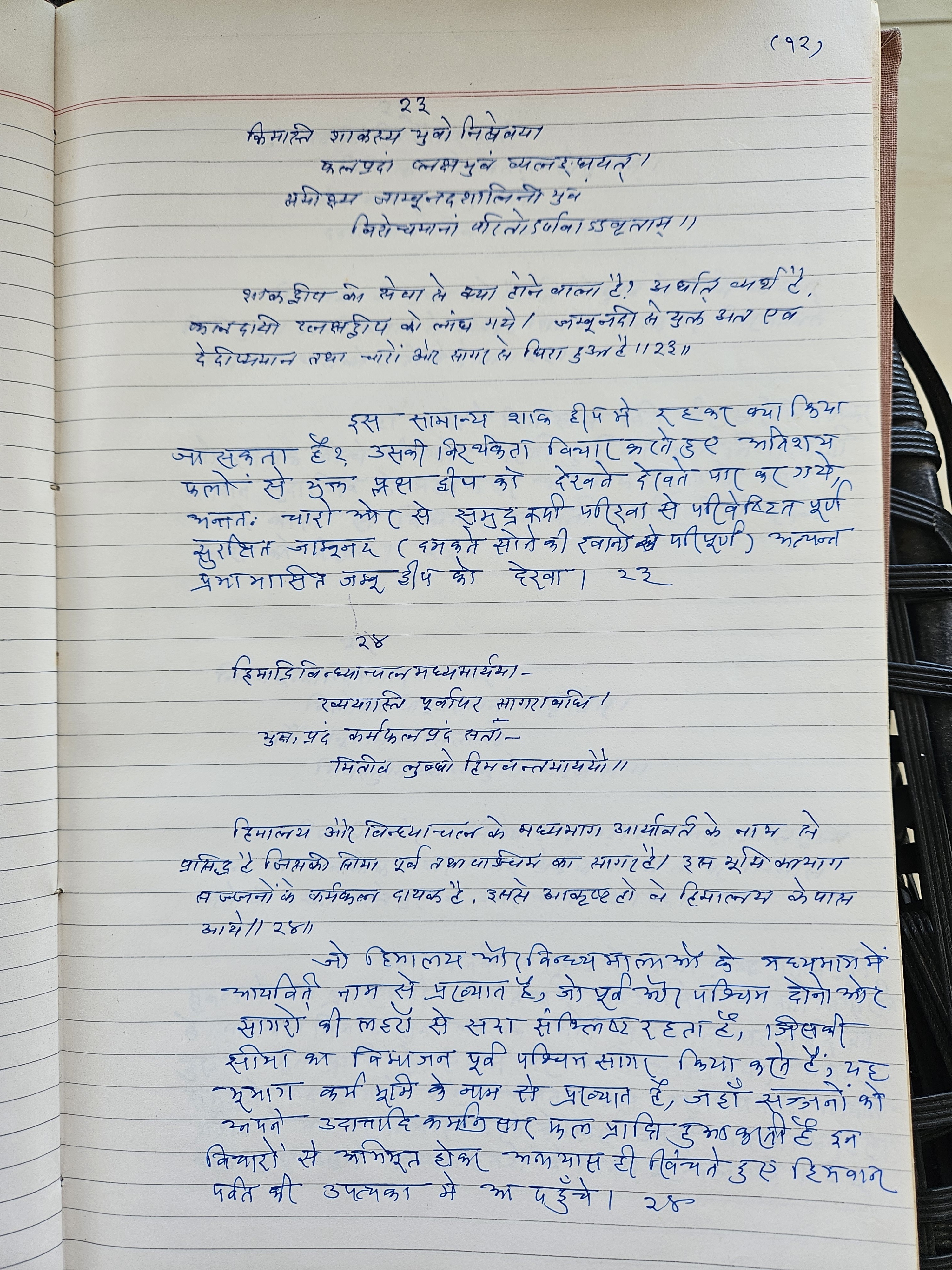
Verse 23
Shlokamanuensis's hand
किमास्ति शाकस्य भुवो निषेवया
फलप्रदं प्लक्षमुखं व्यलङ्घयत् ।
समीक्ष्य जाम्बूनदशालिनीं भुवं
निषेव्यमानां परितोऽर्णवाऽऽवृताम् ॥ २३ ॥
Manuscript NoteAI-assisted transcription
वृत्त: वंशस्थ। पूर्व पाठ "…लक्षमुमं व्यलङ्घयत् / … निषेचमानां परितोऽम्बुनावृताम्" भ्रान्त था।
Manuscript Note (EN)AI-assisted transcription
Metre: Vaṃśastha. The earlier reading ("…लक्षमुमं व्यलङ्घयत् / … निषेचमानां परितोऽम्बुनावृताम्") was wrong.
English Translation (of the Sanskrit)AI-assisted translation
"What is there in living on the land of Śāka?" [So thinking,] he passed over fruitful Plakṣa and the rest, and saw the land shining with gold (Jambūdvīpa), well frequented and surrounded on every side by the ocean. (23)
Translationamanuensis's hand
शाकद्वीप की सेवा से क्या होने वाला है? अर्थात् व्यर्थ है। फलदायी प्लक्षद्वीप को लाँघ गये। जम्बूनदी से युक्त अत एव देदीप्यमान तथा चारों ओर सागर से घिरा हुआ है ॥ २३ ॥
English Translation (of the Hindi)AI-assisted translation
What will come of serving Śākadvīpa? That is, it is useless. He passed over fruitful Plakṣadvīpa. [He saw the land that is] joined with the Jambū river, and so shining, and surrounded on all sides by the sea. (23)
Notesgrandfather's hand
इस सामान्य शाकद्वीप में रहकर क्या किया जा सकता है? उसकी निरर्थकता विचार करते हुए अतिशय फलों से युक्त प्लक्ष द्वीप को देखते देखते पार कर गये, अन्ततः चारों ओर से समुद्ररूपी परिखा से परिवेष्टित पूर्ण सुरक्षित जाम्बूनद (दमकते सोने की खानों से परिपूर्ण) अत्यन्त प्रभाभासित जम्बूद्वीप को देखा। २३
English NotesAI-assisted translation
"What can be done by living in this ordinary Śākadvīpa?" Thinking of its pointlessness, he passed over Plakṣadvīpa, full of fruit, while looking at it. At last he saw Jambūdvīpa, fully protected and surrounded on all sides by the moat of the sea, jāmbūnada (full of mines of gleaming gold), and very radiant. (23)
Verse 24
Shlokamanuensis's hand
हिमाद्रिविन्ध्याचलमध्यमार्यमा-
ख्ययाऽस्ति पूर्वापरसागरावधि ।
सुखप्रदं कर्मफलप्रदं सता-
मितीव लुब्धो हिमवन्तमाययौ ॥ २४ ॥
Manuscript NoteAI-assisted transcription
वृत्त: वंशस्थ। पूर्व पाठ "…मध्यमार्यमा- / रख्यास्ति … / युष्मत्प्रदं …" भ्रान्त था; पाद ३ "सुखप्रदं" हस्तलेख में स्पष्ट है।
Manuscript Note (EN)AI-assisted transcription
Metre: Vaṃśastha. The earlier reading ("…मध्यमार्यमा- / रख्यास्ति … / युष्मत्प्रदं …") was wrong; "सुखप्रदं" is clear in pāda 3.
English Translation (of the Sanskrit)AI-assisted translation
Between the Himālaya and the Vindhya ranges is [the land] named Ārya[varta], reaching from the eastern to the western sea; thinking "it gives happiness and gives the good the fruit of their deeds", he came to the Himālaya as if drawn by longing. (24)
Translationamanuensis's hand
हिमालय और विन्ध्याचल के मध्यभाग आर्यावर्त के नाम से प्रसिद्ध है जिसकी सीमा पूर्व तथा पश्चिम का सागर है। इस भूमि का भाग सज्जनों के कर्मफल दायक है, इससे आकृष्ट हो वे हिमालय के पास आये ॥ २४ ॥
English Translation (of the Hindi)AI-assisted translation
The middle region between the Himālaya and the Vindhya mountains is famous by the name Āryāvarta; its boundaries are the eastern and western seas. This part of the earth gives the good the fruit of their deeds; drawn by this, he came near the Himālaya. (24)
Notesgrandfather's hand
जो हिमालय और विन्ध्यमालाओं के मध्यभाग में आर्यावर्त नाम से प्रख्यात है, जो पूर्व और पश्चिम दोनों ओर सागरों की लहरों से सदा संश्लिष्ट रहता है, जिसकी सीमा का विभाजन पूर्व पश्चिम सागर किया करते हैं, यह भूभाग कर्मभूमि के नाम से प्रख्यात है, जहाँ सज्जनों को अपने उदात्तादि कर्मानुसार फल प्राप्ति हुआ करती है, इन विचारों से अभिभूत होकर अनायास ही खिंचते हुए हिमवान् पर्वत की उपत्यका में आ पहुँचे। २४
English NotesAI-assisted translation
The middle region between the Himālaya and the Vindhya ranges is famous by the name Āryāvarta. It is always touched by the waves of the seas on both east and west, and the eastern and western seas mark its boundaries. This land is famous by the name Karmabhūmi (land of action), where the good obtain fruit according to their noble deeds. Moved by these thoughts, and drawn without effort, he arrived in the valley of the Himavān mountain. (24)