Verse 31
Shlokamanuensis's hand
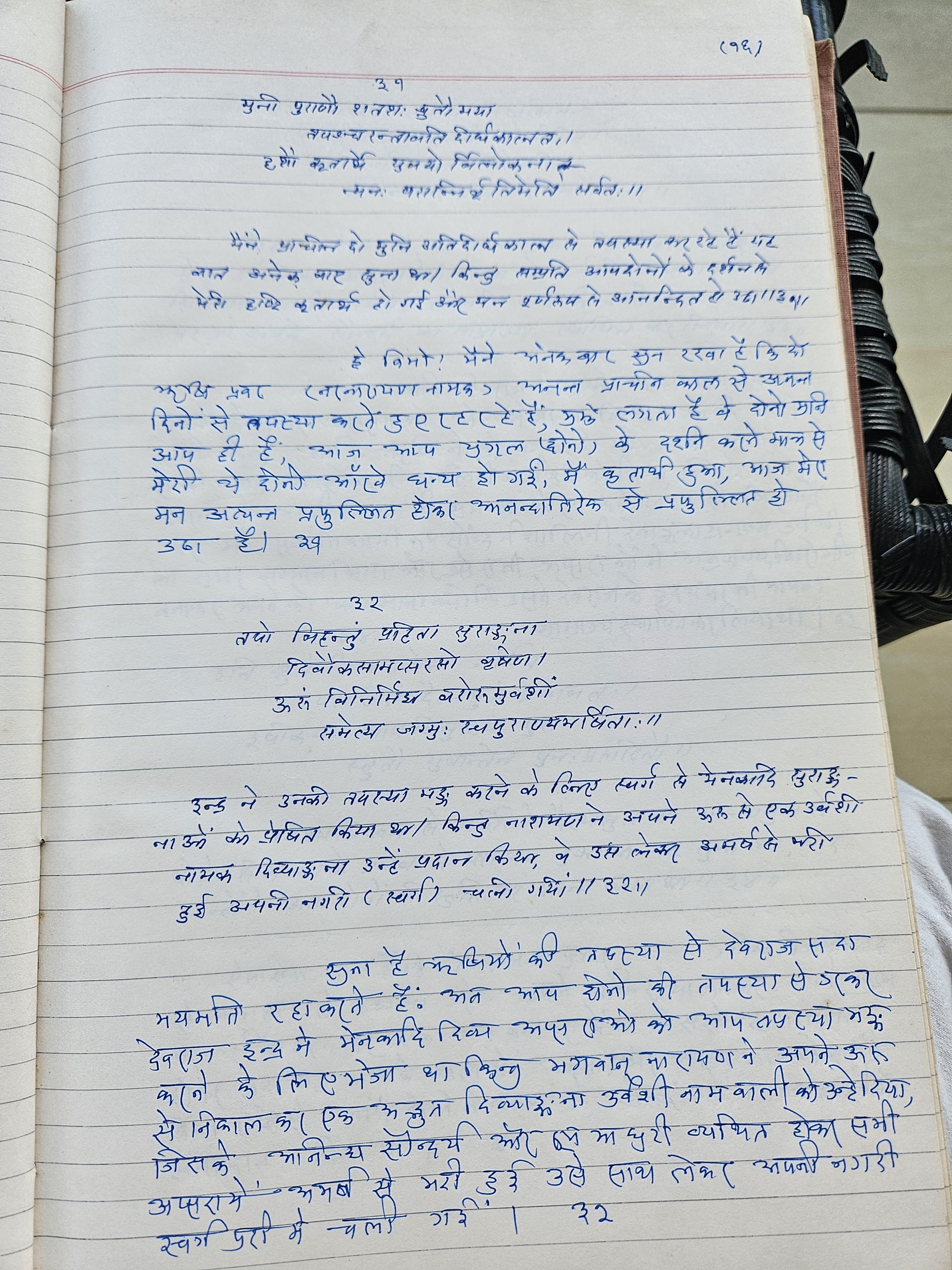
मुनी पुराणौ शतशः श्रुतौ मया
तपश्चरन्तावतिदीर्घकालतः ।
दृशौ कृतार्थे युवयोर्विलोकनात्
मनः परां निर्वृतिमेति सर्वतः ॥ ३१ ॥
Manuscript NoteAI-assisted transcription
वृत्त: वंशस्थ (चारों पाद शुद्ध)। पूर्व पाठ के पाद ३–४ ("तौ कृतार्थो युष्मद्विलोकनात् / न्मनः सन्नितिमेति…") भ्रान्त थे।
Manuscript Note (EN)AI-assisted transcription
Metre: Vaṃśastha (all four pādas scan). The earlier reading of pādas 3–4 ("तौ कृतार्थो युष्मद्विलोकनात् / न्मनः सन्नितिमेति…") was wrong.
English Translation (of the Sanskrit)AI-assisted translation
"Hundreds of times I have heard of the two ancient sages practising austerity for a very long time. My eyes are fulfilled by seeing you two, and my mind attains supreme bliss on every side." (31)
Translationamanuensis's hand
मैंने प्राचीन दो मुनि अतिदीर्घकाल से तपस्या कर रहे हैं यह बात अनेक बार सुना था। किन्तु सम्प्रति आपदोनों के दर्शन से मेरी दृष्टि कृतार्थ हो गई और मन पूर्णरूप से आनन्दित हो रहा ॥ ३१ ॥
English Translation (of the Hindi)AI-assisted translation
"I had heard many times that two ancient sages have been practising austerity for a very long time. But now, by seeing you both, my sight has been fulfilled and my mind is wholly joyful." (31)
Notesgrandfather's hand
हे विभो! मैंने अनेक बार सुन रखा है कि दो ऋषि प्रवर (नरनारायण नामक) अनन्त प्राचीन काल से अगणित दिनों से तपस्या करते हुए रह रहे हैं, मुझे लगता है वे दोनों मुनि आप ही हैं, आज आप युगल (दोनों) के दर्शन करने मात्र से मेरी ये दोनों आँखें धन्य हो गईं, मैं कृतार्थ हुआ, आज मेरा मन अत्यन्त प्रफुल्लित होकर आनन्दातिरेक से प्रफुल्लित हो उठा है। ३१
English NotesAI-assisted translation
"Lord! I have often heard that two excellent sages (named Nara and Nārāyaṇa) have been living here practising austerity since endlessly ancient times, for countless days. I feel that you are those two sages. Today, merely by seeing you two, these two eyes of mine are blessed, I am fulfilled, and today my mind, greatly delighted, has blossomed with overflowing joy." (31)
Verse 32
Shlokamanuensis's hand
तपो निहन्तुं प्रहिता सुराङ्गना
दिवौकसामप्सरसो वृषेण [unclear] ।
ऊरुं विनिर्भिद्य वरोरुमुर्वशीं
समेत्य जग्मुः स्वपुराण्यमर्षिताः ॥ ३२ ॥
Manuscript NoteAI-assisted transcription
वृत्त: वंशस्थ/इन्द्रवंशा (उपजाति)। पाद २ पाण्डुलिपि में "दिवौकसामप्सरसो वृषेण" लिखा है, जो एक अक्षर कम (११) है; कोई अक्षर छूटा प्रतीत होता है। पाद ३ में "विनिर्भिद्य" का पाठ अर्थ (नारायण की ऊरु से उर्वशी) के आधार पर; अक्षर "विनिर्मिद्य" जैसे दिखते हैं। पूर्व पाठ "वृषणा / उरु विनिर्मित" भ्रान्त था।
Manuscript Note (EN)AI-assisted transcription
Metre: Vaṃśastha/Indravaṃśā (Upajāti). Pāda 2 is written "दिवौकसामप्सरसो वृषेण", one syllable short (11); a syllable seems to have dropped out. In pāda 3, "विनिर्भिद्य" is read from the sense (Urvaśī from Nārāyaṇa's thigh); the letters look like "विनिर्मिद्य". The earlier reading ("वृषणा / उरु विनिर्मित") was wrong.
English Translation (of the Sanskrit)AI-assisted translation
"The divine women, the apsarases of the dwellers in heaven, sent by Indra to destroy [your] austerity, met Urvaśī of the lovely thighs, whom [Nārāyaṇa] produced by splitting open his thigh, and went back to their own city, indignant." (32)
Translationamanuensis's hand
इन्द्र ने उनकी तपस्या भङ्ग करने के लिए स्वर्ग से मेनकादि सुराङ्गनाओं को प्रेषित किया था। किन्तु नारायण ने अपने ऊरु से एक उर्वशी नामक दिव्याङ्गना उन्हें प्रदान किया, वे उसे लेकर अमर्ष से भरी हुई अपनी नगरी (स्वर्ग) चली गयीं ॥ ३२ ॥
English Translation (of the Hindi)AI-assisted translation
"Indra had sent Menakā and other divine women from heaven to break your austerity. But Nārāyaṇa gave them a divine woman named Urvaśī, from his thigh; taking her, they went back to their city (heaven), filled with indignation." (32)
Notesgrandfather's hand
सुना है ऋषियों की तपस्या से देवराज सदा भयभीत रहा करते हैं। अतः आप दोनों की तपस्या से डरकर देवराज इन्द्र ने मेनकादि दिव्य अप्सराओं को आप [की] तपस्या भङ्ग करने के लिए भेजा था किन्तु भगवान् नारायण ने अपने ऊरु से निकाल कर एक अद्भुत दिव्याङ्गना उर्वशी नाम वाली को उन्हें दिया, जिसके अनिन्द्य सौन्दर्य और माधुरी [से] व्यथित होकर सभी अप्सरायें अमर्ष से भरी हुई उसे साथ लेकर अपनी नगरी स्वर्गपुरी में चली गईं। ३२
English NotesAI-assisted translation
"I have heard that the king of the gods is always afraid of the austerities of sages. So, frightened by the austerity of you both, Indra, king of the gods, sent Menakā and other divine apsarases to break your austerity. But Lord Nārāyaṇa brought out from his thigh a wonderful divine woman named Urvaśī and gave her to them; pained by her flawless beauty and sweetness, all the apsarases, full of indignation, took her with them and went to their city, Svargapurī." (32)