Verse 7
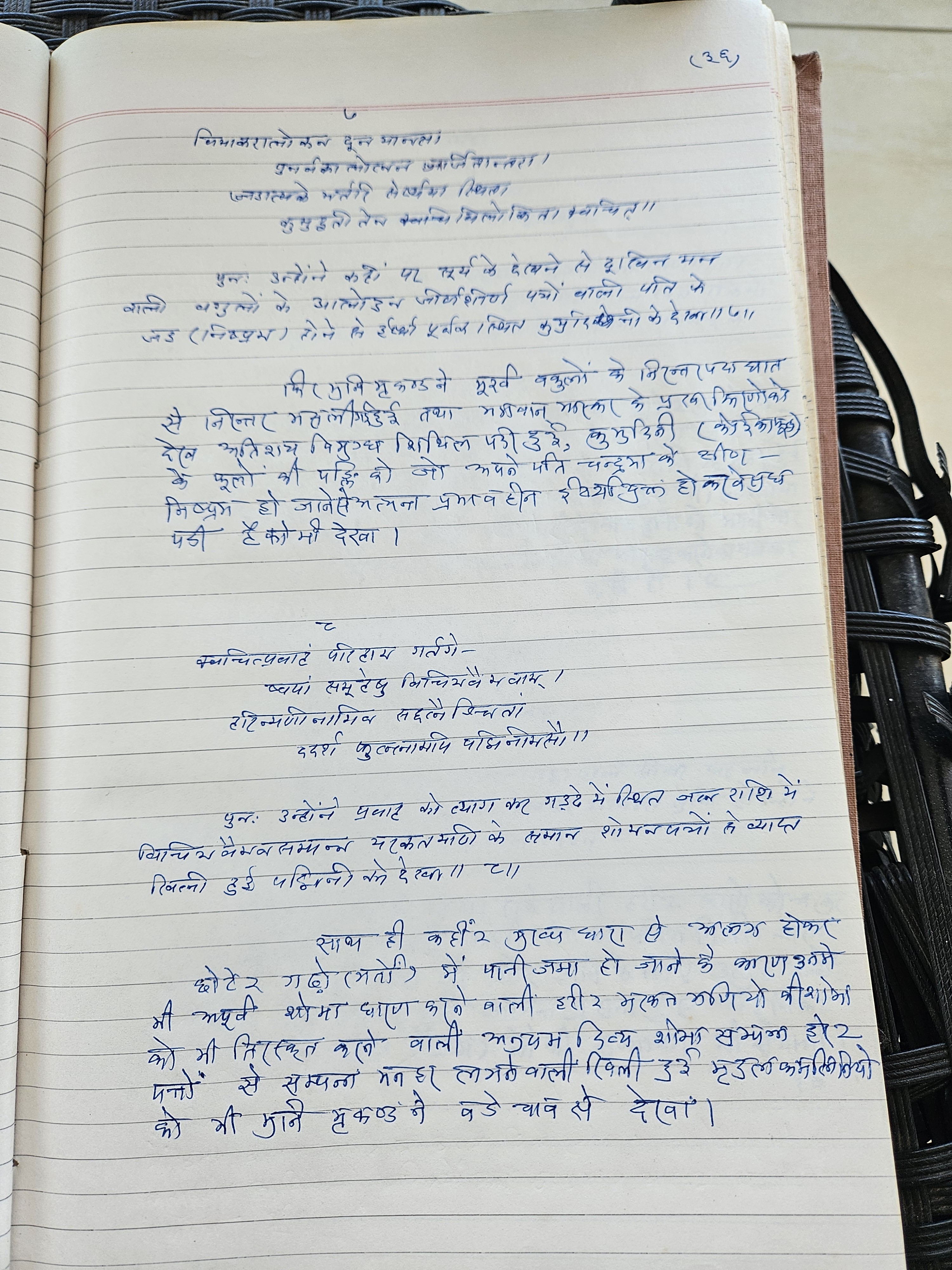
Shlokamanuensis's hand
विभाकरालोकन दूय मानसा
पुनर्बका लोडन जीर्णतन्त्वरा।
जडात्मके भर्त्तरि सेर्ष्यया स्थिता
कुमुद्वती तेन क्वचिद्विलोकिता ॥ ७ ॥
Manuscript NoteAI-assisted transcription
वृत्त: वंशस्थ। पाद ३ "सेर्ष्यया" (पूर्व "सेर्ष्याका")। पाद ४ में "क्व" से पूर्व ह्रस्व को लघु माना गया है (कवि की छूट)।
Manuscript Note (EN)AI-assisted transcription
Metre: Vaṃśastha. Pāda 3 reads "सेर्ष्यया" (earlier "सेर्ष्याका"). In pāda 4 the short vowel before "क्व" is treated as light (the poet's licence).
English Translation (of the Sanskrit)AI-assisted translation
Somewhere he saw a night lotus, her mind pained at the sight of the sun, her slender stalk worn by the herons' stirring, standing with jealousy because her husband [the moon] was dull. (7)
Translationamanuensis's hand
पुनः उन्होंने कहीं पर सूर्य के देखने से दूषित मन वाली बगुलों के आलोडन जीर्णशीर्ण पत्रों वाली पति के जड़ (निष्प्रभ) होने से ईर्ष्या पूर्वक स्थित कुमुद्वती को देखा ॥ ७ ॥
English Translation (of the Hindi)AI-assisted translation
Again, somewhere he saw the night lotus (kumudvatī), her mind afflicted at seeing the sun, her leaves worn and torn by the herons' stirring, standing in jealousy because her husband had become dull (lustreless). (7)
Notesgrandfather's hand
फिर मुनि मृकण्ड ने मूर्ख बकुलों के निरन्तर पदघात से निरन्तर मसली गई हुई तथा भगवान भास्कर के प्रखर किरणों को देख अतिशय विमुग्ध शिथिल पड़ी हुई, कुमुदिनी (कोई का फूल) के फूलों की पङ्क्ति को जो अपने पति चन्द्रमा के क्षीण-निष्प्रभ हो जाने से अत्यन्त प्रभावहीन ईर्ष्यायुक्त हो कर बेसुध पड़ी है को भी देखा।
English NotesAI-assisted translation
Then the sage Mṛkaṇḍu also saw a row of night-lotus (koī) flowers, crushed again and again by the constant trampling of the foolish herons, and lying very faint and limp at the sight of the sharp rays of Lord Bhāskara; because their husband the moon had become waned and lustreless, they lay senseless, very dim and full of jealousy. (7)
Verse 8
Shlokamanuensis's hand
क्वचित्प्रवाहं परिहाय गर्तगे-
ष्वपां समूहेषु विचित्रवैभवम् ।
हरिन्मणीनामिव सद्दलैश्चितां
ददर्श फुल्लामपि पद्मिनीमसौ ॥ ८ ॥
Manuscript NoteAI-assisted transcription
वृत्त: वंशस्थ (चारों पाद शुद्ध)। पाद ३ "सद्दलैः" (पूर्व "सदलैः")।
Manuscript Note (EN)AI-assisted transcription
Metre: Vaṃśastha (all four pādas scan). Pāda 3 reads "सद्दलैः" (earlier "सदलैः").
English Translation (of the Sanskrit)AI-assisted translation
Somewhere, in masses of water that had left the stream and lay in hollows, he saw a lotus plant in full bloom, of wonderful splendour, covered with fine leaves like emeralds. (8)
Translationamanuensis's hand
पुनः उन्होंने प्रवाह को त्याग कर गड़्ढे में स्थित जल राशि में विचित्र वैभव सम्पन्न मरकत मणि के समान शोभन पत्तों से व्याप्त खिलती हुई पद्मिनी को देखा ॥ ८ ॥
English Translation (of the Hindi)AI-assisted translation
Again he saw, in the water standing in a hollow, having left the stream, a blooming lotus plant of wonderful splendour, covered with lovely leaves like emeralds. (8)
Notesgrandfather's hand
साथ ही कहीं २ मुख्य धारा से अलग होकर छोटे २ गड्ढों (गर्तो) में पानी जमा हो जाने के कारण उनमें भी अपूर्व शोभा धारण करने वाली हरी २ मरकत मणियों की शोभा को भी तिरस्कृत करने वाली अनुपम दिव्य शोभा सम्पन्न हरे २ पत्तों से सम्पन्न मनहर लगने वाली खिली हुई मृदुल कमलिनियों को भी मुनि मृकण्ड ने बड़े चाव से देखा।
English NotesAI-assisted translation
Also, in places, where water had collected in small hollows, separated from the main stream, the sage Mṛkaṇḍu looked with great delight at the charming, delicate, blooming lotus plants in them, with green leaves of unequalled divine beauty that outshone even green emeralds of rare splendour. (8)