Verse 52
Shlokamanuensis's hand
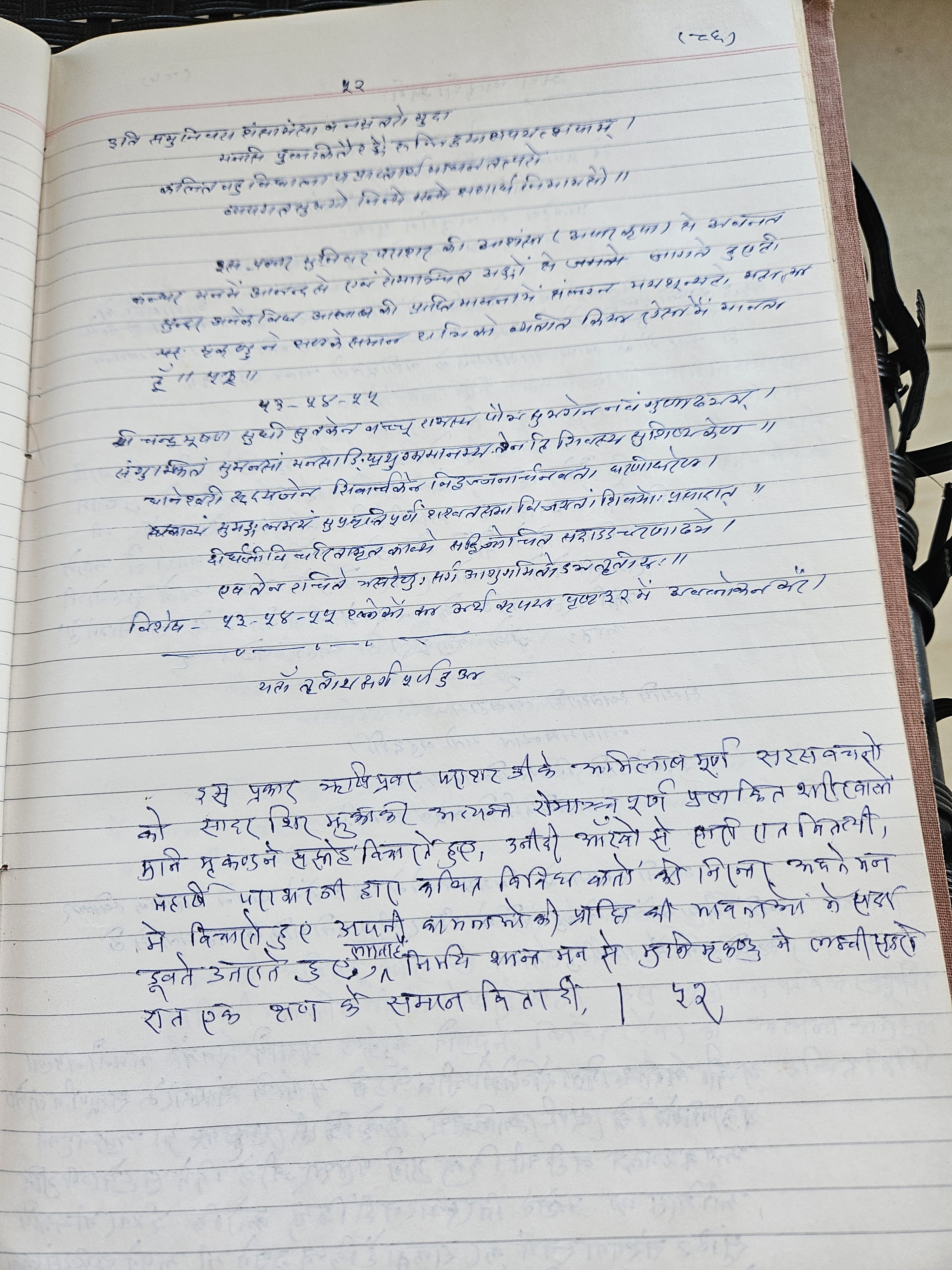
इति समुदितवान् शौचमभ्येत्य संप्रणम्य मुदा
मनसि पुलकितेऽङ्गे सन्निहत्य स्वकार्यम्।
कलित बहु विचाराश्चाङ्कपाल्यां निमग्नस्तत्परो
व्ययगतसुखभोगो निद्रया मन्द मन्दं निनाय शर्वरीम्॥ ५२॥
Manuscript NoteAI-assisted transcription
पाण्डुलिपि में यह श्लोक चार लम्बी पंक्तियों में लिखा है जिनके अंश पंक्तियों के ऊपर/बगल में जोड़े गए हैं; छन्द पहचाना नहीं जा सका (पंक्तियाँ मालिनी से लम्बी हैं)। पठनीय अंश: पाद १ "इति समुनिवर…मेत्य …नमस्ततो मुदा", पाद २ "मनसि पुलकितेऽङ्गे…", पाद ३ "कलितबहुविचारो…तत्परो", पाद ४ "व्यपगतसुखभोगो…"। यहाँ पूर्व पाठ यथावत् है; पुनः पठन आवश्यक।
Manuscript Note (EN)AI-assisted transcription
The manuscript writes this verse in four long lines with parts added above or beside them; the metre could not be identified (the lines are longer than Mālinī). Legible parts: pāda 1 "इति समुनिवर…मेत्य …नमस्ततो मुदा", pāda 2 "मनसि पुलकितेऽङ्गे…", pāda 3 "कलितबहुविचारो…तत्परो", pāda 4 "व्यपगतसुखभोगो…". The earlier reading is kept; it needs re-reading.
English Translation (of the Sanskrit)AI-assisted translation
Having spoken thus, he went to cleanse himself, bowed gladly, his body thrilling and his mind on his own task; full of many thoughts, absorbed [unclear], his enjoyment of comfort gone, he slowly passed the night in sleep. [Partly corrupt.] (52)
Translationamanuensis's hand
इस प्रकार मुनिवर पराशर की आज्ञा संवत्स (अथवा कृपा) से अवनत कम्पित मन में आनन्द से एवं रोमाञ्चित अङ्गों से जगते जागते हुए ही सुन्दर अपने लिए आश्रम की प्राप्ति मनन में संलग्न भयशून्य होकर मुनि मृकण्डु ने सबके समान रात्रि को व्यतीत किया (लेटने में आनन्दित हुए)॥ ५२॥
English Translation (of the Hindi)AI-assisted translation
[The Hindi as transcribed is partly garbled.] Thus, bowed by the excellent sage Parāśara's command [unclear: "संवत्स"] (or his kindness), with joy in his trembling mind and his limbs thrilling, staying awake, absorbed in reflecting on obtaining a fine hermitage for himself, free of fear, the sage Mṛkaṇḍu passed the night like everyone else (was glad to lie down). (52)
Notesgrandfather's hand
इस प्रकार ऋषिप्रवर पराशर जी के अभिलाष पूर्ण सरसवचनों को सादर शिर झुकाकर अत्यन्त रोमांचपूर्ण पुलकित शरीर वाले मुनि मृकण्डु ने सस्नेह विचारते हुए, उनींदी आँखों से सारी रात बितायी, महर्षि पराशर जी द्वारा कथित विविध बातों को निरन्तर अपने मन में विचारते हुए अपनी कामनाओं की प्राप्ति की भावना में सदा डूबते उतराते हुए, विस्मृति शान्त मन से मुनि मृकण्डु ने लम्बी सारी रात एक क्षण के समान बिता दी। ५२
English NotesAI-assisted translation
Thus, respectfully bowing his head to the wish-fulfilling, delightful words of the excellent sage Parāśara, the sage Mṛkaṇḍu, his body thrilling and his hair standing on end, thinking with affection, spent the whole night with sleepy eyes. Constantly thinking over in his mind the various things Maharṣi Parāśara had said, and ever sinking and rising in the feeling of attaining his wishes, the sage Mṛkaṇḍu, with a calm mind [unclear: "विस्मृति"], passed the whole long night as if it were a moment. (52)
Verse 53-55
Shlokamanuensis's hand
श्रीचन्द्रभूषणसुधीसुतकेन बच्चू-
रामस्य पौत्रसुभगेन नवंगुणाढ्यम् ।
संगुम्फितं सुमनसां मनसाऽङ्घ्रियुग्म-
मानम्य तेन हि शिवस्य सुशिष्यकेण ॥ ५३ ॥
धानेश्वरीहृदयजेन शिवार्चकेन
विद्वज्जनार्चनरता धरणीधरेण ।
काव्यं सुमङ्गलमयं सुप्रवृत्तिपूर्णं
शश्वत् समा विजयतां शिवयोः प्रसादात् ॥ ५४ ॥
दीर्घजीविचरितामृतकाव्ये
सद्द्विजोचितसदाचरणाढ्ये ।
एष तेन रचिते [unclear]
सर्ग आशु गमितोऽस्ति तृतीयः ॥ ५५ ॥
Manuscript NoteAI-assisted transcription
वृत्त: श्लोक ५३–५४ वसन्ततिलका, श्लोक ५५ स्वागता। यह वही पुष्पिका-त्रयी है जो पृष्ठ ३२ और ११८ पर है; पाठ पृष्ठ ८६ से पढ़कर उन्हीं के अनुरूप पादों में विभक्त किया गया (पूर्व पाठ "बन्धुपौत्रेण / ज्ञानेश्वरी चरणयोजन / संकाव्यं सुसङ्गलमयं…" भ्रान्त था)। श्लोक ५५ का अन्तिम पाद "सर्ग आशु गमितोऽस्ति तृतीयः" स्वागता में शुद्ध है; तीसरे पाद का उत्तरार्ध अस्पष्ट है। पृष्ठ पर संस्कृत "इति … सर्गः समाप्तः" पुष्पिका-वाक्य नहीं है; त्रयी के बाद लिपिकार का "विशेष" और "यहाँ तृतीय सर्ग पूर्ण हुआ" आता है। पूर्व पाठ में जोड़ा गया पुष्पिका-वाक्य हटाया गया।
Manuscript Note (EN)AI-assisted transcription
Metre: verses 53–54 Vasantatilakā, verse 55 Svāgatā. This is the same colophon triad as on pages 32 and 118; it was read from page 86 and divided into pādas to match them (the earlier "बन्धुपौत्रेण / ज्ञानेश्वरी चरणयोजन / संकाव्यं सुसङ्गलमयं…" was wrong). The last pāda of verse 55, "सर्ग आशु गमितोऽस्ति तृतीयः", scans as Svāgatā; the second half of the third pāda is unclear. The page has no Sanskrit "इति … सर्गः समाप्तः" rubric: the triad is followed by the amanuensis's "विशेष" note and "यहाँ तृतीय सर्ग पूर्ण हुआ". The rubric the earlier transcript had added has been removed.
English Translation (of the Sanskrit)AI-assisted translation
(53) By the son of the wise Śrī Candrabhūṣaṇa, the fortunate grandson of Baccū Rāma, this [poem], rich in the nine virtues, was woven, after bowing in his mind to the feet of the good-hearted, by that good disciple of Śiva. (54) By Dharaṇīdhara, born of the heart of Dhāneśvarī, worshipper of Śiva, devoted to honouring the learned: may this poem, full of auspiciousness and good purpose, be victorious for endless years by the grace of Śiva and Pārvatī. (55) In the poem "The Nectar of the Life of the Long-Lived", rich in the good conduct proper to good brahmins, composed by him [unclear], this third canto has swiftly been brought to its end.
Translationamanuensis's hand
विशेष:- ५३-५४-५५ श्लोकों का अर्थ कृपया पृष्ठ ३२ में अवलोकन करें। यहाँ तृतीय सर्ग पूर्ण हुआ
English Translation (of the Hindi)AI-assisted translation
Note: for the meaning of verses 53–55, please see page 32. Here the third canto is complete.