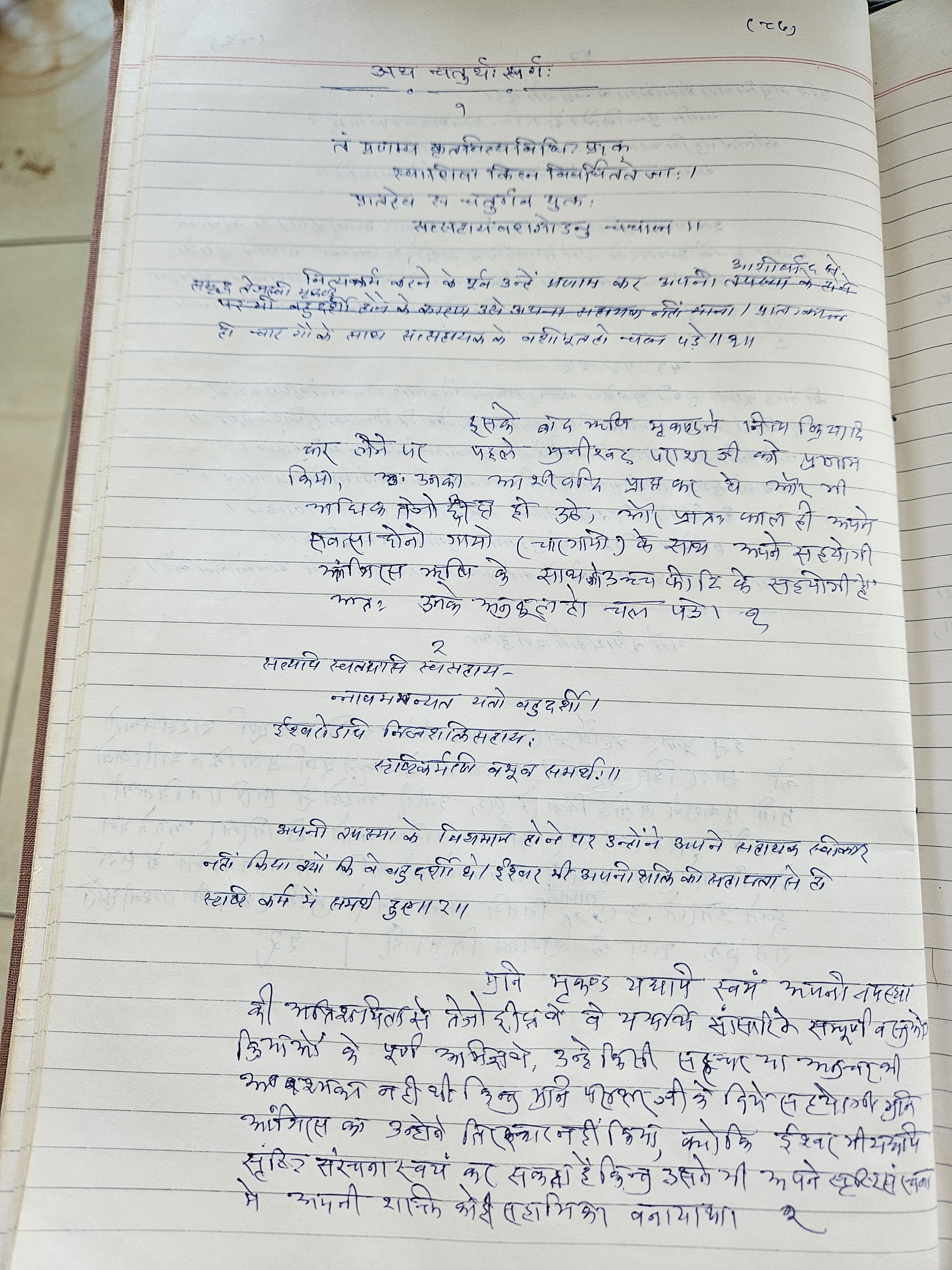
Verse 1
Shlokamanuensis's hand
तं प्रणम्य कृतनित्यविधिः प्राक्
स्वाशिषा किल विवर्धिततेजाः ।
प्रातरेव स चतुर्गवयुक्तः
सत्सहायवशगोऽनु चचाल ॥ १ ॥
Manuscript NoteAI-assisted transcription
वृत्त: स्वागता (ऽ।ऽ ।।। ऽ।। ऽऽ)। हिन्दी अनुवाद में लिपिकार ने "तपस्या के बल पर भी बहुदर्शी होने के कारण उसे अपना सहायक नहीं माना" काटकर ऊपर "आशीर्वाद से" लिखा है, तथा बाएँ हाशिये में "समृद्ध तेजस्वी मुनिवर" जोड़ा है।
Manuscript Note (EN)AI-assisted transcription
Metre: Svāgatā. In the Hindi translation the amanuensis struck out "तपस्या के बल पर भी बहुदर्शी होने के कारण उसे अपना सहायक नहीं माना" and wrote "आशीर्वाद से" above it; "समृद्ध तेजस्वी मुनिवर" is added in the left margin.
English Translation (of the Sanskrit)AI-assisted translation
Having first performed his daily rites and bowed to him (Parāśara), his splendour increased by his blessing, he set out at dawn itself with his four cattle, following the guidance of his good companion. (1)
Translationamanuensis's hand
समृद्ध तेजस्वी मुनिवर नित्यकर्म करने के पूर्व उन्हें प्रणाम कर अपनी आशीर्वाद से प्रातःकाल ही चार गौ के साथ सत्सहायक के वशीभूत हो चल पड़े ॥ १ ॥
English Translation (of the Hindi)AI-assisted translation
The sage, grown rich in splendour, bowed to him before performing his daily rites, and with his blessing set out at dawn itself with four cows, guided by his good companion. (1)
Notesgrandfather's hand
इसके बाद ऋषि मृकण्डु ने नित्य क्रियादि कर लेने पर पहले मुनीश्वर पराशर जी को प्रणाम किया, उनका आशीर्वाद प्राप्त कर वे और भी अधिक तेजोदीप्त हो उठे, और प्रातःकाल ही अपने सवत्सा दोनों गायों (चार गायों) के साथ अपने सहयोगी आंगिरस ऋषि के साथ जो उच्च कोटि के सहयोगी हैं, अतः उनके अनुकूल हो चल पड़े। १
English NotesAI-assisted translation
After this, when Sage Mṛkaṇḍu had completed his daily rites, he first bowed to the lord of sages, Parāśara. Having received his blessing, he became still more radiant. At dawn he set out with his two cows and their calves (four cattle), together with his companion, Sage Āṅgirasa, a companion of the highest rank, and so proceeded in harmony with him. (1)
Verse 2
Shlokamanuensis's hand
सत्यपि स्वतपसि स्वसहाय-
न्नाभ्यमन्यत यतो बहुदर्शी ।
ईश्वरोऽपि निजशक्तिसहायः
सृष्टिकर्मणि बभूव समर्थः ॥ २ ॥
Manuscript NoteAI-assisted transcription
वृत्त: स्वागता।
Manuscript Note (EN)AI-assisted transcription
Metre: Svāgatā.
English Translation (of the Sanskrit)AI-assisted translation
Though his own austerity sufficed, being far-sighted he did not count on a helper of his own; yet even the Lord became able in the work of creation only with His own Śakti as helper. (2)
Translationamanuensis's hand
अपनी तपस्या के विद्यमान होने पर उन्होंने अपने सहायक स्वीकार नहीं किया क्यों कि वे बहुदर्शी थे। ईश्वर भी अपनी शक्ति की सहायता से ही सृष्टि कर्म में समर्थ हुआ ॥ २ ॥
English Translation (of the Hindi)AI-assisted translation
Since his own austerity was present, he did not accept a helper of his own, because he was far-sighted. Even God became able in the work of creation only with the help of His own power. (2)
Notesgrandfather's hand
मुनि मृकण्ड यद्यपि स्वयं अपनी तपस्या की अतिशयिता से तेजोदीप्त थे, वे यद्यपि सांसारिक सम्पूर्ण वस्तुओं क्रियाओं के पूर्ण अभिज्ञ थे, उन्हें किसी सहचर या अनुचर की आवश्यकता नहीं थी किन्तु मुनि पराशर जी के दिये सहयोगी मुनि आंगिरस को उन्होंने तिरस्कार नहीं किया, क्योंकि ईश्वर भी यद्यपि सृष्टि संरचना स्वयं कर सकता है किन्तु उसने भी अपने सृष्टि संरचना में अपनी शक्ति को ही सहायिका बनाया था। २
English NotesAI-assisted translation
Although Sage Mṛkaṇḍa was himself radiant through the intensity of his austerity, and although he knew all worldly things and actions fully and needed no companion or attendant, he did not spurn Sage Āṅgirasa, the companion given by Sage Parāśara. For although God can create the world by Himself, He too made His own Śakti His helper in creating it. (2)