Verse 35
Shlokamanuensis's hand
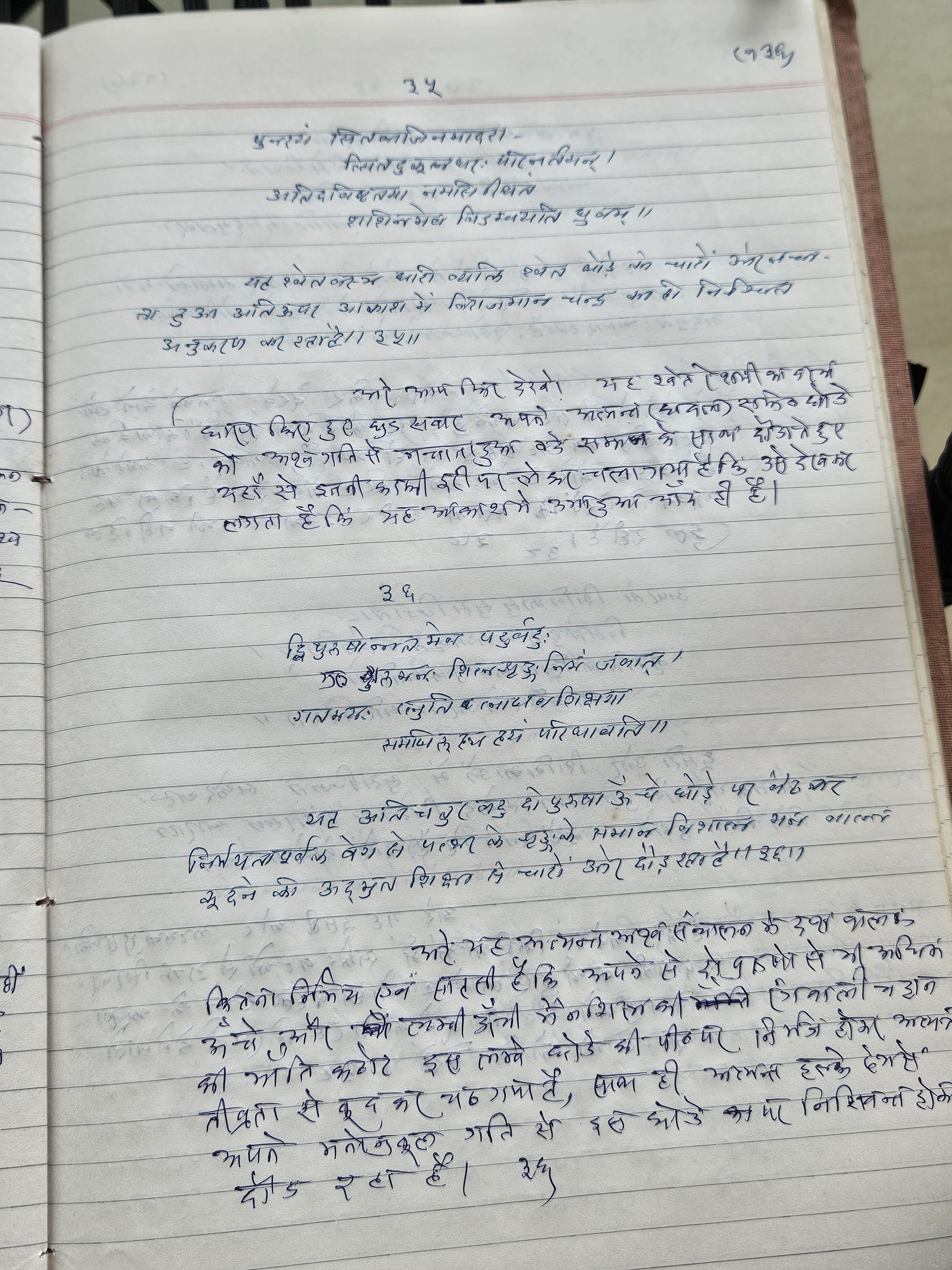
पुनरयं सितवाजिनमादरा-
त्सितदुकूलधरः परिनर्तयन् ।
अतिदविष्ठतया नभसि स्थितं
शशिनमेव विडम्बयति ध्रुवम् ॥ ३५ ॥
Manuscript NoteAI-assisted transcription
वृत्त: द्रुतविलम्बित। पाद १ का अन्त "मावरा-"/"मादरा-" जैसा; पाद २ "त्सित" से आरम्भ होता है, अतः "आदरात्सित…" पढ़ा गया। पाद ३: "अतिदविष्ठतया" (अत्यन्त दूर होने से)।
Manuscript Note (EN)AI-assisted transcription
Metre: Drutavilambita. The end of pāda 1 looks like "मावरा-"/"मादरा-"; pāda 2 begins with "त्सित", so "आदरात्सित…" is read. Pāda 3: "अतिदविष्ठतया" (by being very far off).
English Translation (of the Sanskrit)AI-assisted translation
Again this man, wearing white silk, carefully making his white horse dance, being now very far off, surely mimics the moon standing in the sky. (35)
Translationamanuensis's hand
यह श्वेतवस्त्र धारी व्यक्ति श्वेत घोड़े को नचाता हुआ अति ऊपर आकाश में विराजमान चन्द्र का ही निश्चित अनुकरण कर रहा है ॥ ३५ ॥
English Translation (of the Hindi)AI-assisted translation
This man dressed in white, making his white horse dance, is surely imitating the very moon that sits high in the sky. (35)
Notesgrandfather's hand
ओ! आप फिर देखें! यह श्वेत रेशमी का [unclear: कुर्ता] धारण किए हुए घुड़सवार अपने अत्यन्त (धवल) सफेद घोड़े को अश्वगति से नचाता हुआ बड़े [unclear: सम्मान] के साथ दौड़ाते हुए यहाँ से इतनी काफी दूरी पर लेकर चला गया है कि उसे देखकर लगता है कि यह आकाश में उगा हुआ चाँद ही है ।
English NotesAI-assisted translation
Oh, look again! This horseman, wearing a white silk [unclear: kurtā], making his pure (bright) white horse dance in the horse's gaits and galloping it with great [unclear: dignity], has ridden so far from here that, seeing him, one feels he is the very moon risen in the sky. (35)
Verse 36
Shlokamanuensis's hand
द्विपुरुषोन्नतमेव पटुर्बटुः
[unclear: कुलमजः] शिलशृङ्गनिभं जवात् ।
गतभयः प्लुतिचालकशिक्षया
समधिरुह्य हयं परिधावति ॥ ३६ ॥
Manuscript NoteAI-assisted transcription
वृत्त: द्रुतविलम्बित। पाद २ संदिग्ध: पहले एक अक्षर ("ग"?) काटा गया, फिर "कुलमजः"/"कूलमतः" जैसा शब्द; "शिलशृङ्गनिभं" (शिला/पर्वत-शृङ्ग के समान) लिखित रूप से पढ़ा गया — लिखित रूप छन्द में बैठता है, पर अर्थ अस्पष्ट। हिन्दी: "पर्वत के शृङ्ग के समान विशाल गर्त … कूदने की"। पाद ३: "प्लुति" के बाद एक अक्षर ("क"?) काटा गया।
Manuscript Note (EN)AI-assisted transcription
Metre: Drutavilambita. Pāda 2 is doubtful: a letter ("ग"?) is struck out, then comes a word like "कुलमजः"/"कूलमतः"; "शिलशृङ्गनिभं" (like a rock or mountain peak) is read as written. The written form scans, but the sense is unclear. The Hindi: "jumping a huge pit like a mountain peak". Pāda 3: after "प्लुति" a letter ("क"?) is struck out.
English Translation (of the Sanskrit)AI-assisted translation
This deft lad, mounting a horse a full two men high, fearless, with his training in driving at the leap, swiftly [clears an obstacle] like a rocky peak and gallops all around. (36)
Translationamanuensis's hand
यह अति चतुर बटु दो पुरुषा ऊँचे घोड़े पर बैठकर निर्भयतापूर्वक वेग से पर्वत के शृङ्ग के समान विशाल गर्त [unclear: नालों] कूदने की अद्भुत शिक्षा से चारों ओर दौड़ रहा है ॥ ३६ ॥
English Translation (of the Hindi)AI-assisted translation
This very clever lad, seated on a horse two men high, fearlessly and swiftly, with his wonderful training in leaping huge pits [unclear: and ditches] like mountain peaks, is galloping all around. (36)
Notesgrandfather's hand
अरे! यह [unclear: आत्मना] अश्व संचालन के दृश्य वाला कितना विस्मय एवं साहसी है कि अपने से दो पुरुषों से भी अधिक ऊँचे ~~[कटा हुआ]~~ लम्बी ऊँची [unclear: गिरिशिखर] की ~~भाँति~~ दिखने वाली चट्टान की भाँति कठोर इस लम्बे घोड़े की पीठ पर निर्भीक होकर अत्यन्त तीव्रता से कूदकर चढ़ गया है, साथ ही अत्यन्त हल्के वेग से इस घोड़े ~~का~~ पर निश्चिन्त हो अपने मनोनुकूल गति से दौड़ रहा है । ३६
English NotesAI-assisted translation
Oh! How astonishing and daring is this [unclear] display of horsemanship: he has fearlessly leapt up, with great speed, onto the back of this tall horse, more than two men high, hard as a rock that looks like a tall, high [unclear: mountain peak]; and, at ease on the horse, he is galloping lightly at the pace he pleases. (36)